
The text in this page is generated from pdf file of ‘The Workings of Karma Rev 2’ by Ven. Pa Auk Sayadaw using OCR software. The text conversion accuracy is not 100%. You can download the original pdf file from eBook section. See TOC for table of content. You can leave a message in the ‘Comment’ field at the end of this page if you would like to help out in text correction manually.
VI – THE UNWORKING OF KAMMA
849/8S0
After discussing how the uneducated ordinary person is able only to produce aggregates, The Buddha then discusses the characteristics of the five aggregates.
Is MATERIALITY PERMANENT OR IMPERMANENT?
Let us listen to Him discuss materiality(rupa):
What do you think, bhikkhus, is materiality permanent(nicca)or impermanent(anicca)? (Impermanent, Venerable Sir.)
And what is impermanent, is it suffering(dukkha)or happiness(sukha)? (Suffering, Venerable Sir.)
Then what is impermanent, suffering, a changing thing(viparinama-dhamma), is it proper to regard that as: ‘This is mine(etam mama); this I am(es·oham·asmi); this is my self(eso me atta)’?
(Certainly not, Venerable Sir.)
In the same way, The Buddha discusses the remaining four aggregates: the feeling-, perception-, formations-, and consciousness aggregate. And, of course, in all cases, the bhikkhus confirm that it is improper to regard either of the aggregates as: ‘This is mine, this I am, this is my self.’ That is namely how the uninstructed ordinary person regards the five aggregates.
How then, are the five aggregates impermanent, suffering, and non-self?
IMPERMANENCE
The characteristic of impermanence(anicca) is the arising, perishing, and changing of formations: having existed, they cease to exist.8s1 As we discussed earlier,8s2 the materiality aggregate(rupa·kkhandha)comprises sub-atomic particles that in Pali are called rupa·kalapas. If we develop jhana or access concentration, the light of wisdom arises.8s3 With that light of wisdom, one may be able to discern the elements of the kalapas, and see that as soon as they arise, they perish. The feeling-(vedana.), perception-(sanna), and formations aggregate(sankhara·kkhandha) comprise mental factors(cetasika): they arise and perish together with consciousness, the consciousness aggregate(vinnana·kkhandha). And as we have mentioned now many times,854 within one snap of the fingers, very many thousand million consciousnesses arise and perish. With proper vipassana meditation, based on jhana or access concentration, one may see this directly with one’s own insight knowledge. One will directly see how the five aggregates are in fact nothing more than impermanence(anicca). Happiness cannot be found in something that is impermanent. That is why The Buddha says the five aggregates are suffering(dukkha).257
849 the unworking of kamma: the undoing of kamma, the making it ineffective, bringing it to nothing.
8S0 Reference numbers in italics refer to sutta quotations, etc. in endnotes beginning p.349.
8S1 VsM.xxi.740 ‘Upakkilesa· Vimutta-Udaya·Bbaya·Nana-Katha’ (‘Discussion of CorruptionFree Arise&Perish Knowledge’) PP.xxi.6
8S2 See ‘Ultimate Materiality’, p.90.
8S3 See ‘The Light of Wisdom’, p.86.
8S4 See, for example, ‘The Workings of the Mind’, p.39.
316
The Workings of Kamma
SUFFERING
The characteristic of suffering(dukkha) is continuous oppression by arising and perishing.8ss Painful feelings of the body are suffering and painful feelings of the mind are suffering. But also pleasant feelings are suffering, because they are impermanent, which means they will change: when they change, there is suffering. The same with equanimous feelings. They too are impermanent, which means they will also change.258 And according to conventional truth, when the five aggregates arise at rebirth, impermanence arises as ageing, sickness,259 and death. And at the next birth, it is again ageing, sickness, and death, etc. Thus the five aggregates are impermanent, and changing all the time: that means they are suffering. Ultimately, they can never comprise happiness.257That is why The Buddha says the five aggregates are a burden(bhara):8s6 He even says they are Mara.8S7
NON-SELF
The characteristic of non-self(an·atta) is that the five aggregates are beyond control. 260 One cannot decide, for example: ‘I want the five aggregates to be like this, not like that!’ Or, ‘In this life, I want to see, hear, smell, taste, touch only pleasant objects! No pain, no change, and no ageing, sickness and death, please!’ We cannot control the five aggregates in that way. So how can we say there is a self? That is why The Buddha asks the bhikkhus whether it is proper to regard the five aggregates as: ‘This is mine(etam mama); this am I(es·oham·asmi); this is my self(esomeatta).’ And the bhikkhus agree by saying it is certainly not proper to regard the five aggregates in that way.
CLINGING TO SUFFERING
Here we need to understand that when one delights in the five aggregates, it means one in fact delights in suffering.251 When one regards the five aggregates as associated with a self, it means one in fact regards suffering as self, and one clings to suffering as self: 262 one takes suffering as one’s refuge. Doing so, one cannot ever understand the Noble Truth of Suffering. If one does not understand the Noble Truth of Suffering, one cannot ever understand the Noble Truth of the Origin of Suffering, or the Noble Truth of the Cessation of Suffering: that means one will never escape suffering. Like the dog bound to the post, one will always be bound to the five aggregates. One will continue being reborn again and again to renewed birth, renewed ageing, renewed sickness, and renewed death.263 So it is not difficult to understand that it is improper to regard the aggregates as associated with a self.
THEREFORE, BHIKKHUS, ANY WHATSOEVER MATERIALITY
Having established how the aggregates should not be regarded, The Buddha then explains how the aggregates rightly should be regarded, according to reality (yatM·bhOta), with Right Wisdom(Samma·Paiiii”a), that is, insight wisdom{l1pa.s.;ana·panna).
8SS VsM.ibid.
856 S.IILI.iii.l ‘Bhara·Suttam'(‘The Burden Sutta’) 857 S.IILILi.l ‘Mara·Suttam'(‘The Mara Sutta’)
VI- The Unworking of Kamma
317
Therefore, bhikkhus, any whatsoever materiality,
[1-3] past, future, or present(atit-iiniigafiJ·paccuppannam}, [4-5] intemal or extemal(ajjhatliJm va bahiddha va),
[6-7] gross or subtJe(ofiiJikam va sukhumam va),
[8-9] inferior or superior(hinam va panitam va),
[10-11] far or near(yam dOre santike va),
all materiality(sabbam rOpam), in this way is to be regarded aa:ording to reality and with Right Wisdom as: ‘This is not mine(n·etam mama), I am not this(n·eso·ham·asmi), this is not my self(na meso attii).’
In the same way, The Buddha explains how the remaining aggregates should be regarded with insight knowledge: the aggregate of eleven categories of feeling, and the aggregates of eleven categories of perception, formations, and consciousness.8S8 To be able to discern them one needs, of course, to have developed the light of wisdom, which arises with jhana or access concentration.8s9 Otherwise one cannot discern the five aggregates, for they can be discerned only by the wisdom eye(pafifiii-cakkhu). 264
What do these eleven categories mean? Let us discuss them one by one, first with relation to the aggregate of eleven categories of materiality(rOpa).860
MATERIALITY
Earlier we discussed materiality(rOpa). It is:861
· The four great essentials(maha·bhOta): earth-, water-, fire-, and wind element.
· Materiality derived from the four great essentials(maha·bhOtanam upadaya·fijpam).862 twenty-four kinds of materiality, such as colour, odour, flavour, nutritive essence, life faculty, heart-materiality, sex-materiality, and translucent materiality.
1-3) MAlERIALITY PAST, FUTURE, OR PRESENT
By any whatsoever materiality(yam kifid rOpam), The Buddha means all materiality without exception. By any whatsoever materiality, past, future, or present(atit-iinagata-paccuppannam), He means past, future, or present materiality seen in four ways:
1) According to extent(addha), materiality that arose before the arising of this life’s rebirth-linking consciousness is past (materiality of past lives). Materiality that arises after the arising of this life’s decease consciousness is future materiality (materiality of future lives). And materiality that arises in-between is present materiality (materiality in the course of this Iife).863
8S8 See also quotation at ‘The Five Clinging-Aggregates’, p.89. 8S9 For details, see ‘The Ught of Wisdom’, p.86.
860 All details taken from The Buddha’s explanations in Vbh.Li ‘Suttanta·Bh~aniyam'(‘Suttanta Oassification’) and from VbhAjVbhT; VsM.xiv.447’ROpa·Kkhandha·Katha'(‘Discussion of Materiality Aggregate’) PP.xiv.73 & VsM.ibid.493-503J4M·Adi·li7.bhaga·Katha'(‘Discussion of the Past, etc. Oassification’) PP.ibid.185-210.
861 For details, see ‘Ultimate Materiality’, p.90.
862 derived materiality: so-called because it derives from, depends upon, the four great essentials. The Texts compare it to plants, which grow dependent on the earth.
863 Explaining present extent, VsM.xiii.416 ‘Pakinnaka·Katha’ (‘Discussion of the Miscellaneous’) PP.xiii.114 refers to M.IILiv.l ‘Bhaddeka·Ratta·Suttam'(‘The Excellent-Night Sutta’), but see endnote 147, p.242.
318
The Workings of Kamma
2) According to continuity(5C1I1laU), materiality of one series of generations of temperature- or nutriment-born rDpa-kalapas is present; of a previous series is past; and of a subsequent series is future.864 Consciousness-born materiality born of one mental process or one attainment is present, of a previous mental process, etc., is past; of a subsequent is future. Kamma-born materiality is past, future and present according to the materiality that supports it.
3) According to period(samaya), materiality that arose as a continuity in one minute, during one morning, evening, day, etc., is present. Previous materiality is past, and subsequent is future.
4) According to moment(khana), materiality of one arising, standing, and dissolution is present. Previous such materiality is past, and subsequent is future.
Here, of course, for the practice of insight(vpas-sana), only the momentary past, future, and present apply.86s To see materiality according to reality is to see only ultimate materiality: the individual element of each type of rDpa-kalapa as it arises, stands, and dissolves. That means the Noble Disciple discerns the impermanence, suffering, and non-self nature of materiality moment by moment in the present life, in the past lives that have been discerned, and in the future lives that have been discerned.866 And the same for temperature-, nutriment-, and consciousness-born materiality moment by moment, and in the smaller periods of present, past and future.
4-5) MATERIALITY INTERNAL OR ExTERNAL
Materiality internal or extemal(ajjhattath va bahiddhii va): here, The Buddha is referring to one’s own materiality as internal, and others’ materiality as external. Also, the internal bases (eye-, ear-, nose-, tongue-, and body base) are internal, whereas their objects (the external bases: sight-, sound-, odour-, f1avour-, and tangible base) are external. And here again, we need to remember that the eye base is not the lump of flesh sitting in the eye socket: that is a concept. According to reality, it is non-existent. 867 One cannot do vipassana on things that do not exist. When The Buddha speaks of the eye, the eye element, the eye door, and the eye base, He means the eye translucency(cokkhupas-iida): the tenth element of eye decad-kalapas: that is the existent eye.868 The same for the other bases.
6-7) MATERIALITY GROSS OR SUBTLE
Materiality gl’OSS or subtle(of.n-am va sukhumam va): here, The Buddha is referring to the twelve bases as gross: eye-, sight-, ear-, sound-, nose-, odour-, tongue-, f1avour-, and body-, and tangible base. They are gross because they impinge
864 series of generations: for details, see ‘The Four Origins of Materiality’, p.95.
86S VsM.xiv.494J4M.Adi.Ii7Miiga.Kathii'(‘Discussion of the Past, etc. Classification’) PP.ibid.191 explains that only the momentary is not iIIustrative(ni-wa$1ya), as it is actual and real. But the others are iIIustrative(sapa$1ya), as they serve only to make clear and explain.
866 VsMT.xx.725 Vdaya·Bbaya·Niina·Kathii· Vannanii’ (‘Description of the Discussion of the Arise&Perish Knowledge’) explains that having seen the arising and perishing of formations in the present, one then sees it in past and future.
867 See footnote 280, p.91.
868 In Vbh.II.156 l4yatana· Ii7Maligo'(‘Base Analysis’), The Buddha explains: ‘Therein, what is the eye base? The eye that, deriving from the four great essentials, is translucent, belonging to oneself, invisible, impingent… this is the eye, this is the eye element, this is the eye faculty, this is a world, this is a door….’
VI- The Unworking of Kamma
319
upon each other: a sight impinges upon the eye, and eye consciousness arises, etc. The remaining types of materiality (such as nutritive-essence, life faculty, heart-materiality, and sex-materiality) do not impinge, which means they are seen as subtle.
8-9) MA lERIALITY INFERIOR OR SUPERIOR
Materiality inferior or superior(hinam va panitam 16″): here, The Buddha is referring to materiality of superior and inferior beings: a Brahma’s materiality is superior to a sensual-sphere deva’s materiality; a human being’s materiality is inferior to a sensual-sphere deva’s materiality, but superior to a ghost’s materiality, which is superior to an animal’s materiality, etc. The same applies to the external materiality in their realms of existence. And material things that civilized people consider agreeable and inoffensive are superior, whereas the things they consider disagreeable and offensive are inferior.869 In terms of vipassana practice, however, materiality that arises owing to unwholesome kamma is inferior, whereas materiality that arises owing to wholesome kamma is superior.
10-11) MAlERIALITY FAR OR NEAR
Materiality far or near(yamdOn’.scmtike 16″): here, The Buddha is referring to materiality in terms of space(okas”a).870 Thus, one’s own materiality is near, whereas another’s materiality is far. Materiality inside one’s room is near, whereas materiality outside on the monastery grounds is far. Materiality on the monastery grounds is near, whereas materiality outside is far. Materiality within the country is near, materiality outside the country is far, etc.
That concludes our explanation of the eleven categories of materiality which make up the materiality aggregate. One needs to contemplate all those categories of materiality as impermanent, suffering, and non-self. Then there are the eleven categories of feelings that make up the feeling aggregate.
FEELINGS
The Buddha speaks of feelings in many ways. The main way is the three types
of feeling(Vfdana):871
1) Pleasant feeling(sukha·Vfdana)
2) Painful feeling(dukkha·vedana)
3) Neither-painful-nor-pleasant feeling(a-dukkha·ma·sukha·vedana): that is, neutral feeling.
1-3) FEELINGS PAST, FUlURE, OR PRESENT
Whatever feeling past, future, or present(atit-anagata·paccuppanna): here again, The Buddha is referring to all feelings without exception. By past, future and present, He means the same four as with materiality.
869 VbhA.ibid refers here to accountants, chief ministers, lords, men of property, and merchants. And it explains that although pigs may be happy to eat dung, and unhappy to lie down on a fine couch, they confuse the agreeable with the disagreeable because of perception-perversion. See ‘The Four Perversions’, p.326.
870 subtle materiality is far, because it is difficult to discern, and gross materiality is near, because it is easy to discern
871 M.ILi.9 Wahu· Vedanijta·Suttam'(‘The Many Kinds of Feeling Sutta’)
320
The Workings of Kamma
1) According to extent(addha), feelings that arose before the arising of this life’s rebirth-linking consciousness are past (feelings of past lives). Feelings that arise after the arising of this life’s decease consciousness are future feelings (feelings of future lives). And feelings that arise in-between are present feelings (feelings in the course of this life).
2) According to continuity(5C1I1laU), feelings of one mental process or attainment, or with one object, are present; of a previous mental process, etc., are past; of a subsequent are future. For example, the feeling that arises while seeing a certain Buddha image, while making a certain offering, while listening to a certain Dhamma talk, etc. are present. 872 Such previous events are past, and such subsequent events are future.
3) According to period(5Clmaya), feelings that arose in one minute, during one morning, evening, day, etc., are present. Previous feelings are past, and su bseq uent futu re.
4) According to moment(khana), the feeling of one arising, standing, and dissolution of consciousness is present. Previous such feelings are past, and subsequent are future.
4-5) FEELINGS INTERNAL OR ExTERNAL
Feeling internal or extemal(ajjhatta va bahiddha va): here, The Buddha is referring to one’s own feelings as internal, and others’ feelings as external.
6-7) FEELINGS GROSS OR SUBllE
Feeling gl’OSS or subtle(ofanka va sukhuma va): here, The Buddha means feelings seen in four ways:
1) According to species(ja17): for example, unwholesome feelings are gross, whereas wholesome feelings are subtle. But wholesome feelings are gross compared to resultant feelings, whereas the Arahant’s feelings (which are functional) are subtle.
2) According to individual essence(sabhava): painful feeling is gross, whereas pleasant- and neutral feeling is subtle. But painful- and pleasant feeling is gross whereas neutral feeling is subtle.
3) According to person(puggala): the feelings of one who has jhana is subtle because there is only one object, whereas the feelings of one with no jhana is gross because there are many objects.
4) According to mundane and supramundane(lok&’a-lokuttalll): feelings associated with defilements are gross, whereas feelings dissociated from defilements are subtle.
When discerning feelings in this way, one must not confuse the categories: for example, according to species, bodily pain is a subtle feeling because it is indeterminate(neither unwholesome nor wholesome), but according to individual essence it is gross because it is painful.
There are many other ways in which one may categorize feelings as gross and subtle. For example:
· Feelings associated with hatred are gross, whereas those associated with greed are subtle.
872 VsMT says it is present even it if it lasts the whole day_
VI- The Unworking of Kamma
321
· Those associated with long-lasting hatred are gross, whereas those associated with brief hatred are subtle.
· Those associated with greed and wrong view are gross, whereas those associated with greed and no wrong view are subtle.
· Feelings of the sensual sphere are gross, whereas those of the fine-material sphere are subtle, although they are gross compared with feelings of the immaterial sphere.
· Feelings associated with offering are gross, whereas feelings associated with morality are subtle, although they are gross compared with feelings associated with meditation.
· Feelings associated with inferior offering, morality, or meditation are gross, whereas feelings associated with superior offering, morality, or meditation are subtle.
· The solely painful feelings in hell are gross, whereas painful feelings in the animal world are subtle, but they are gross compared to painful feelings in the ghost world, and so on up to the highest of the sensual-sphere deva worlds, where painful feelings are only subtle. And the same for pleasant feelings, from the animal world up to the fourth jhana Brahma plane, and the solely equanimous feelings of the highest Brahma plane, the fifth-jhana plane, and the immaterial planes.
8-9) FEELINGS INFERIOR OR SUPERIOR
Feeling inferior or superior(hm8 va panita va): here, gross feelings are inferior, and subtle feelings are superior.
10-11) FEELINGS FAR OR NEAR
Feeling far or near(ya dOresantike va): here, gross and inferior feelings are far from subtle and superior feelings. But gross and inferior feelings are near other gross and inferior feelings, and subtle and superior feelings are near other subtle and superior feelings.
That concludes our explanation of the eleven categories of feelings which make up the feeling-aggregate. One needs to contemplate all those categories of feeling as impermanent, suffering, and non-self.
The eleven categories of perception, formations and consciousness should be understood in the same way as the eleven categories of feelings.
The Buddha says each aggregate of these eleven categories is to be regarded (dattflabbam)according to reality(yatM·bhOta), and with Right Wisdom(Samma·Jpannaya) as: ‘This is not mine, not this am I, this is not my self.’ That is His instructions for vipassana meditation.
THE COMPREHENSION KNOWLEDGE
Such knowledge of the impermanent, suffering, and non-self nature of the five aggregates, is what we call the Comprehension Knowledge(Sammasana·N8(1a): we mentioned it before.873 It is knowledge of the three characteristics of all groupings. That is:
873 The insight knowledges discussed here are summarized under ‘The Sixteen Insight Knowledges’, p.l09.
322
The Workings of Kamma
· comprehending the impermanent, suffering, and non-self nature of the six internal bases (eye-, ear-, nose-, tongue-, body-, and mind base);
· comprehending the impermanent, suffering, and non-self nature of the six external bases (sight-, sound-, odour-, f1avour-, tangible-, and dhamma base);
· comprehending the impermanent, suffering, and non-self nature of the eighteen elements (the eye-, ear-, nose-, tongue-, body-, and mind element; the sight-, sound-, odour-, f1avour-, tangible-, and dhamma element; and the eye-, ear-, nose-, tongue-, body-, and mind-consciousness element);
· comprehending the impermanent, suffering, and non-self nature of the twelve factors of dependent origination (ignorance, volitional formations, consciousness, etc.).
One contemplates the three characteristics of the five aggregates in this way over and over again.
THE ARISE&PERISH CONTEMPLATION KNOWLEDGE
As one’s insight knowledge becomes deeper and deeper, there then arises the Arise&Perish Contemplation Knowledge(Udaya·Bbay·Anupa.s:sana·Nana). With this knowledge, one knows and sees the causal and momentary arising and perishing of the five aggregates at every consciousness moment from the rebirth-linking consciousness up to the death consciousness of every past life one has discerned. One knows the same for this life, and all the future lives one has discerned, up to one’s Parinibbana. One knows and sees how the five aggregates are in this way possessed of impermanence, suffering, and non-self. And one knows this also of the insight consciousnesses by which one has known and seen this. Everywhere one looks, in the entire universe, one sees only the arising and passing away of aggregates: their impermanence, suffering, and non-self nature. Again, one contemplates the arising and perishing of the five aggregates in this way over and over again. When one’s insight knowledge becomes sharp and bold, one concentrates on only the dissolution of the five aggregates.
THE DISSOLUTION-CONTEMPLATION KNOWLEDGE
With the Dissolution-Contemplation Knowledge(Bhang·Anupa.s:sana·Nana), one no longer pays attention to the arising stage of the five aggregates: one pays attention only to their dissolution stage. Again, one practises in this way over and over again. Regarding the aggregates in this way, one gains more powerful knowledge of how they are all possessed of impermanence, suffering, and non-self. Everywhere one looks, in the entire universe, all one sees is dissolution. And one pays attention also to the dissolution of the consciousnesses that with insight know the dissolution of the aggregates.874
As one contemplates the five aggregates in this way, again and again, one’s insight knowledge becomes stronger and stronger, and eventually the five aggregates appear fearsome to the yogi, because all the time they break up like pottery, all the time they are dispersed like fine dust. If you watch the surface of a river during heavy rain, you will see water bubbles all the time appearing and
874 VsM.xxi.742 ‘Bharig·Anupassana·Nana-Katha’ (‘Discussion of the Dissolution-Contemplation Knowledge’) PP.xxi.13 explains: ‘Hence the Ancients said: “He sees with insight both the known and the knowledge”.’
VI- The Unworking of Kamma
323
bursting: that is how the five aggregates now appear to the yogi.87s Here again, one contemplates the dissolution of the five aggregates in this way, over and over again. As one’s insight knowledge becomes more and more profound, seeing the five aggregates dissolve ever and ever again, one eventually becomes disenchanted with the five aggregates.26S
THUS SEEING, BHIKKHUS
Disenchantment with the five aggregates is the next stage described by The
Buddha in the second ‘Gaddula’Baddha’sutta:876
Thus seeing, bhikkhllS, the educated Noble Disciple(5lItava AIiya·savako) [1] with this very materiality is disenchanted(n7pa.smim·pi nibbindati); [2] with this very feeling is disenchanted(l<edanaya·pi nibbindati);
[3] with this very perception is disenchanted(safifiaya·pi nibbindati);
[4] with these very formations is disenchanted(sankh.nsu·pi nibbindati);
[5] with this very COnsdOllSness is discenchanted(vifiiiana.smim:pi nibbindati).
When the educated Noble Disciple has become disenchanted with the five aggregates, it means she or he has become dissatisfied with the five aggregates. She or he no longer delights in them, is no longer enchanted by them: be they the aggregates of a human being, a deva, a Brahma, etc. 266 With the arising of such disenchantment, the mind inclines towards Nibbana. Let us see how this change takes place.
THE EDUCATED NOBLE DISCIPLE Is DISENCHANTED
Disenchantment with the five aggregates has three aspects:877
1) The five aggregates appear as fearsome: that is the Fearsomeness-Appearance Knowledge(Bhayat·Upattf/8na·N8(1a).
2) Because the five aggregates are fearsome, one realizes they are dangerous: that is the Danger-Contemplation Knowledge(Aa7nav·Anupa.s:sana·N8(1a).
3) Because the five aggregates appear as fearsome and dangerous, one becomes disenchanted with them: that is the Disenchantment-Contemplation Knowledge(Nibbid·AnupassanaiJana).
The five aggregates of past, future, and present, of all worlds, appear as fearsome, because inevitably they dissolve. The VisuddiNagga explains it with a simi1e.878 Say a woman’s three sons had offended the king, and he ordered them to
87S The similes have been taken from VsM.ibid.748/PP.ibid.27: see also ‘The Five Voidness Similes’.
876 S.IILLx.8’Dutiya.Gaddula.Baddha.Suttam'(‘The Second Oog-Bound Sutta’)
877 VsM.xxi.755 Wibbid·Anupassana·Nana-Katha’ (‘Discussion of the Disenchantment-Contemplation Knowledge’) explains that seeing formations as fearsome and dangerous is the same as becoming disenchanted with them: ‘Hence the Ancients said: “Knowledge of Appearance as Fearsome while one only has three names: it sawall formations as fearsome, thus the name ‘Appearance as Fearsome’ arose; it aroused [the appearance of] danger in those same formations, thus the name ‘Contemplation of Danger’ arose. It arose, becoming disenchanted with those same formations, thus the name ‘Contemplation of Disenchantment’ arose.” Also it is said in the text [PsM.Lv.227/PD.Lv.81]: “Understanding of Appearance as Fearsome, Knowledge of Danger and Disenchantment: these things are one in meaning, only the letter is different:”
878 VsM.xxi.750 ‘Bhayat·Upatf/7ana·Nana·Katha’ (‘Discussion of the Fearsome-Appearance Knowledge’) PP.xxi.30
324
The Workings of Kamma
be executed. And the woman went to the execution. When they had cut the eldest son’s head off, they set about cutting the middle son’s head off. Seeing the eldest son’s head already cut off, and middle son’s head about to be cut off, the mother lost all hope for the youngest son. She knew he would also have his head cut off. Her eldest son’s head having been cut off is like one’s having seen past aggregates cease. The middle son’s head being cut off is like one’s seeing present aggregates ceasing. And the mother’s knowledge that the youngest son’s head would also be cut off is like one’s knowing that future aggregates will also cease. That is how there arises the Fearsomeness-Appearance Knowledge(Bhayat-UpattMna·Nana).
This does not mean that fear and terror arise in the yogi:879 just knowledge about the inevitable dissolution of the aggregates. If one saw three charcoal pits, they would look fearsome: one would know that no matter which charcoal pit one were to fall into, one would suffer great pain unto death. But that mere knowledge would not make one afraid. In the same way the aggregates of past, future, and present look fearsome, but one is not for that reason afraid. Whatever aggregate one contemplates, it appears fearsome because one sees it as oppressed ~ dissolution. For that reason also, the five aggregates appear as dangerous. 0
Wherever one looks, there is no safety to be found. The three types of existence (sensual-, fine-material-, and immaterial existence) appear dangerous, the four great essentials (the earth-, water-, fire, and wind element) appear dangerous, the six internal bases (eye-, ear-, nose-, tongue-, body-, and mind base) appear dangerous, and the six external bases (sight-, sound-, odour-, f1avour-, tangible-, and mind-object base) appear dangerous. All destinations appear dangerous: burning with what The Buddha calls the eleven fires.267 That is, the hells, the animal world, the ghost world, the human world, the sensual-deva realms, the Brahma realms, and the immaterial realms, wherever the rebirth consciousness can arise, all destinations appear to the yogi as burning, blazing and glowing with the fire of lust, the fire of hatred, the fire of delusion, the fires of birth, ageing, and death, and the fires of sorrow, lamentation, pain, displeasure, and despair. The aggregates appear as aggregates of danger, without anything satisfactory, without anything substantial. The Buddha says they appear as a disease (raga), as a tumour(ganifa), as a dart(5ClUa), as misery(agha), as an affliction(abadha), as only danger(acffnava,e68 nothing else. That is how there arises the Danger-Contemplation Knowledge(Acffnav·Anupa.s:sana·N8(1a).
Now we shall ask you one question. What are all these dangerous things? Can we describe them all as one thing only? Yes, we can. We may say that all these things are just the workings of kamma. That is, the accomplishment of kamma, and the results of kamma: the resultant mentality-materiality.881 That is in fact what now appears dangerous to the yogi.
879 VsM.ibid.751/PP.ibid.32
880 VsM.ibid.752 ‘Adinav·Anupassana·Nana·Katha’ (‘Discussion of the Danger-Contemplation Knowledge’) PP.ibid.35-36.
881 In Vbh.vi.2341’apaa·Samuppao’a·li7bhaligo'(‘Analysis of Dependent Origination’), The Buddha explains this as kamma existence(kamma·bhava): meritorious-, demeritorious-, and imperturbable formation of kamma. It produces rebirth existence(upapatti·bhava), which is the foundation of the rebirth consciousness in the appropriate realm: the human/finematerial realms, the woeful realms, and the immaterial realms respectively. See also quotations endnotes 65, p.231 and 74, p.232.
VI- The Unworking of Kamma
325
THE DANGER OF THE WORKINGS OF KAMMA
What do we do when we are in danger? We seek safety, refuge, and shelter from the danger. The workings of kamma now appear as fearsome and as suffering to the yogi. He sees them therefore as dangerous, and he sees safety(khema) and happiness(5lIkha) as somewhere with no workings of kamma. And the only place with no workings of kamma is in the State of Peace(Santi-Pada), Nibbana.259
In practical terms, what does the yogi see as fearsome and suffering, and what as safety, happiness, and Nibbana?882
· Arising(uppada) in this life because of past kamma(pun’ma·kamma) is fearsome and suffering, whereas non-arising(an·uppada) in this life is safety, happiness, and Nibbana.
· The occurrence(pavatta) of these results of kamma is fearsome and suffering, whereas non-occurrence(a·pavatta) of these results of kamma is safety, happiness, and Nibbana.
· The sign(nimitta) of formations is fearsome and suffering, whereas the signless (animitta) is safety, happiness, and Nibbana.
· Accumulation(a)ll7hana)of kamma is fearsome and suffering, whereas nonaccumulation(an·a)ll7hana)of kamma is safety, happiness, and Nibbana.
· Rebirth-linkingiPatfs”andhlj into the next life is fearsome and suffering, whereas no rebirth-Iinking(a·ppatfs”andhlj into a future life is safety, happiness, and Nibbana.
· The destination(gab’) of rebirth-linking is fearsome and suffering, whereas no destination(a·gab’) for rebirth-linking is safety, happiness, and Nibbana.
· Generation(nibbatti) of the aggregates is fearsome and suffering, whereas no generation(anibbatti) of the aggregates is safety, happiness, and Nibbana.
· Re-arising(upapatti) of the results of kamma is fearsome and suffering, whereas no re-arising(an·upapatti) of the results of kamma is safety, happiness, and Nibbana.
· Birth, ageing, sickness, death, sorrow, lamentation, pain, displeasure, and despair are fearsome and suffering, whereas no birth, no ageing, no sickness, no death, no sorrow, no lamentation, no pain, no displeasure, and no despair is safety, happiness, and Nibbana.
Once the arising, standing, and perishing of the aggregates are in this way seen as fearsome and suffering, and the non-arising, non-standing, and non-perishing of the aggregates is seen as safety, happiness, and Nibbana, it means one is disenchanted with formations, and one’s mind inclines naturally towards Nibbana.270 That is how there arises the Disenchantment-Contemplation Knowledge(Nbbid·AnupassanalJiina).
As one then continues to contemplate the impermanence, suffering, and nonself of the five aggregates of past, future, present, internal or external, gross or subtle, inferior or superior, far or near, eventually one develops equanimity towards the five aggregates.
882 This list has been taken from PsM.I.8 :4dinava·Nana·Niddeso’ (‘Exposition of the Danger Knowledge’) PD.I.viii.300-305: quoted in VsM.ibid.752 :4dinav·Anupassana·Nana-Katha’ (‘Discussion of the Danger-Contemplation Knowledge’) PP.ibid.37. The elaborations are from VsM.ibid.753/PP.ibid.38-42.
326
The Workings of Kamma
EQUANIMITY TOWARDS THE FIVE AGGREGATES
Equanimity towards the five aggregates has also three aspects:883
1) There arises the desire and longing to renounce and give up the five aggregates: that is the Release-Longing Knowledge(Muiidtu·Kamyata·NanaJ.
2) With the desire for release there is repeated, and increasingly profound, reflection on the five aggregates as devoid of permanence, devoid of happiness, devoid of self, and devoid of beauty: that is the Reflection Knowledge (Pafisatikh·kupassana·Nana). It is the means for release.
3) With the longing for release and the increasingly profound reflection on the voidness of the five aggregates, one sees that they are full of faults: that is the Formations-Equanimity Knowledge(Salikhar·Upekkha·Nana). At this stage, one no longer looks upon the five aggregates as either delightful or fearsome: one looks upon them with equanimity, which means one has finally become detached from them.
We have mentioned the Formations-Equanimity Knowledge very many times.
All the Arahants we have discussed were able to attain Arahantship because they developed this knowledge many times in the past, under previous Buddhas. It is the highest mundane insight knowledge there is. If one’s parami are mature, the next step is the actual attainment of Nibbana, with Stream Entry.
THE FoUR PERVERSIONS
It is very important to understand this stage of enlightenment. Why? Because this stage marks the big change from being the uneducated ordinary person (assutava puthu-jjano) to becoming an educated Noble Disciple(sutava AIiya·savako). you will remember how The Buddha discusses these two types of person in the beginning of both ‘Gaddula·Baddha’suttas.884
The uneducated ordinary person is enchanted with the five aggregates, thinking they are aggregates of permanence, happiness, self, and beauty. Because of ignorance(av[fja), the uneducated ordinary person’s understanding of the world (the five aggregates) is distorted; perverted by the four perception-perversions (sanna·vipalliisa), the four consciousness-perversions(dtta·vipalliisa), and the four view-perversionS(d4tf1i·vipalesa).88S They are:271
1) The perception, consciousness, and view that in the impermanent(anicre) there is permanence(niaa).
2) The perception, consciousness, and view that in suffering(dukkhe)there is happiness(sukha).886
883 VsM.xxi.778 ‘Salikhar·Upekkha·Nana-Katha’ (‘Discussion of the Formations-Equanimity Knowledge’) PP.xxi.79 explains: ‘ … the Ancients said: ”This knowledge of equanimity about formations is one only and has three names. At the outset it has the name of ReleaseLonging Knowledge. In the middle it has the name Reflection Knowledge. At the end, when it has reached its culmination, it is called the Formations Equanimity Knowledge.”’ The elaborations are from VsM.ibid.780/PP.ibid.80-81.
884 See ‘The Uneducated Ordinary Person’, p.S, and ‘The Educated Noble Disciple’, p.1S. 88S perversion{vipalla5a): ‘With distorted apprehension as characteristic is perversion.’ Nettippakarana·Pa!iIV.S2 ‘Desana-Hara·Sampato'(‘Discourse on Connotative-Assemblage’) The GuideN.ii.492
886 For an example, see footnote 869, p.319.
VI- The Unworking of Kamma
327
3) The perception, consciousness, and view that in non-self(an·atta) there is self (atta). Earlier, we discussed The Buddha’s analysis of the uneducated ordinary person’s twenty views of self.887
4) The perception, consciousness, and view that in the foul(a5llbha) there is beauty(subha).
Thus, the uneducated ordinary person seeks safety and happiness in herself or himself (internal five aggregates), in her or his mother and father, husband and wife, daughters and sons, friends, property, etc. (external five aggregates).272 Thus, the uneducated ordinary person’s perverted understanding of reality makes Nibbana undesirable: she or he does not want to stop.
CONTEMPLATING VOIDNESS
At this advanced stage of vipassana meditation, however, one works towards seeing the five aggregates with Right Wisdom(Samma·Ppafina). One contemplates the five aggregates according to reality(yatM·b/101iJ) as VOid(5lIfiiia).273 Now, by ‘void’, The Buddha does not mean that the five aggregates, twelve bases, etc., do not really exist; He does not mean that everything is an illusion: that is wrong view. 274 What does not exist is five aggregates that are permanent, stable, eternal, and not subject to change. And what does in reality exist is five aggregates that are impermanent, suffering, and subject to change.275That means they are devoid of permanence, devoid of happiness, devoid of self, and devoid of beauty.
THE FIVE VOIDNESS SIMILES
In the’Phe(la·P;(I¢·Opama’sutta, The Buddha uses five similes to explain how the bhikkhu contemplates the voidness of the five aggregates.888 First He explains that if one were to see a lump of foam floating down the Ganges River, and one were to examine it carefully, one would see that it was only hollow, only insubstantial. And He compares it to insight meditation on materiality:
So too, bhikkhllS, whatever kind of materiality there is, whether past, future, or present; internal or external; gross or subtle; inferior or superior; far or near, if a bhikkhu were to see it(pas:5’eyya), contemplate it(nijjhayeyya), and carefully investigate it(yoniso upapalikkheyyaj; as he saw it, contemplated it, and carefully investigated it, it would appear to him void only, hollow only, insubstantial only. For what substance could there be in materiality?
That is how The Buddha says one should practise insight(vipa.s:sana) on the materiality aggregate. Then He describes how rain falling on water produces water bubbles. If one examines such bubbles, one sees that a bubble arises, then bursts, having no substance. And He compares it to insight meditation on the feelings aggregate:
So too, bhikkhllS, whatever kind of feeling there is, whether past, future, or present; internal or external; gross or subtle; inferior or superior; far or near, if a bhikkhu were to see it, contemplate it, and carefully investigate it; as he saw it, contemplated it, and carefully investigated it, it would appear to him void only, hollow only, insubstantial only. For what substance could there be in feeling?
That is how The Buddha says one should practise insight meditation(vipas-sana·bhavana)on the feelings aggregate. Then He explains how the bhikkhu practises
887 See ‘The Twenty Types of Identity View’, p.ll.
888 S.IILLx.3 ‘Phena·Pin(i-Opama·Suttam'(‘The Lump-of-Foam Simile Sutta’)
328
The Workings of Kamma
insight meditation on the eleven categories of perception: they appear to him as void, hollow, and insubstantial as a mirage. And when the bhikkhu contemplates the eleven categories of formations, they appear to him as void as the trunk of a banana tree. You know, a banana tree has a false trunk: it consists of many rolls. If one removes the many rolls, one will find nothing inside. Lastly, The Buddha explains that when the bhikkhu practises insight meditation on the eleven categories of consciousness, they appear to him as void as a magician’s illusion, a mere trick, devoid of substance. That is how The Buddha says one should practise insight meditation on the five aggregates.
At this stage, one’s insight knowledge is greatly strengthened by one’s having contemplated the five aggregates as fearsome and dangerous, and one’s having become disenchanted with the five aggregates.
VOID OF SELF AND ANYTHING BELONGING TO SELF
Then, as one contemplates the aggregates as void, one understands that they are void of self (‘This is my self’) as well as void of anything belonging to self (‘This is mine’).889 One does not see a self of one’s own (‘my self’);89O one does not see a self that belongs to another, for example, one’s mother (‘I am my mother’s child’), one’s brother (‘I am my brother’s sibling’), or a friend (‘I am my friend’s friend’). One does not see another as having a self that belongs to oneself, for example, one’s mother (‘This is my mother’), one’s brother (‘This is my brother’), or a friend (‘This is my friend’). In the same way one does not see a self that belongs to any property, or any property that has a self.891
This understanding of voidness of self, voidness of self’s property, voidness of substance, etc., one extends to the world: 276 that is, the six internal and external bases, the five aggregates, the six types of consciousness, contact, feeling, perception, volition, craving, application, and six types of sustainment, the six elements, ten kasil)as, thirty-two parts of the body, the eighteen elements, the twelve factors of dependent origination, etc., of past, future, and present.277
LET ONE LOOK ON THE WORLD AS VOID, MOGHARAJA
When one looks upon the world in this way, The Buddha says one cannot be seen by the king of death: Mara. The Buddha explained it once to an ascetic called Mogharaja.892/278He had asked The Buddha how he should look upon the world, in order to escape death. The Buddha’s answer was a verse:
Let one look on the world as void(5lIfiiiali7), Moghari,ia, always mindful;
889 Here, VsM.ibid.760/PP.ibid.53 quotes M.IILi.6 ‘Aneiijasappaya·Suttam’ (The Imperturbable-Wards Sutta’): ‘Again and further, bhikkhus, a Noble Disciple, gone to the forest, or gone to the foot of a tree, or gone to a secluded place, reflects in this way: ‘Void is this of self or of what belongs to self.”’
890 Here, VsM.ibid. again quotes M.IILi.6 ‘Aneii’p5appaya·Suttam'(‘The ImperturbableWards Sutta’): ‘Again and further, bhikkhus, a Noble Disciple reflects in this way: “I am not anywhere anyone’s possession, nor is there anywhere my possessing of anyone [I belong to no one, and no one belongs to me].”’
891 VsA.ibid. and MA.ibid. explain that this refers to voidness of self and property of self in both internal and external aggregates.
892 VsM.xxi.765 ‘Sarikhar·Upekkha·Nana Katha’ (‘Discussion of the Formations-Equanimity Knowledge’) PP.xxi.60 quotes this verse from SuN.v.15’Mogha~a-Manava·Puccha'(‘Young Brahmin Mogharaja’s Questions’).
VI- The Unworking of Kamma
329
Giving up the self view, one may thllS outl1ln death;
Who looks upon the world in this way, the king of death does not see.
The world(loka): this is the five clinging-aggregates. Let him look on the world as vcAd(sufifiato): this means he should look upon the five clinging-aggregates as devoid of permanence, devoid of happiness, devoid of self, and devoid of beauty. Always mindful: this means he should always remember to see these four types of voidness in the five clinging-aggregates. If one contemplates the world in this way, one gives up the self view(attanu·ditfhiJ (the personality view(sakkaya·ditfhi}), and then may one outl1ln death. Who looks upon the world in this, the king of death does not see: 279 the king of death (Mara) cannot see the one who looks upon the world in this way. 280
When the yogi contemplates the five aggregates in this way, again and again, his insight improves, and gradually he abandons both fearsomeness and delight towards the five aggregates: instead, he looks upon them with equanimity. He looks upon them as neither’!’, nor as ‘mine’, nor as ‘self’. To explain this, The Buddha uses the simile of the man who has divorced his wife, and has therefore become indifferent towards her.893
DIVORCE FROM THE FIVE AGGREGATES
Suppose a man were married to a lovely, desirable, charming wife. And suppose he was so in love with her that it was unbearable for him to be without her for even a moment. If he saw her chatting, joking, and laughing with another man, he would be disturbed and displeased, even unhappy. Why? Because he was looking upon her as ‘she is mine’, and he was dependent on her alone for his happiness.
Then later he might discover that she had many faults. And he would divorce her. Once divorced, he would no more look upon her as ‘mine’. And if he now saw her chatting, joking, and laughing with another man, he would not be disturbed and not displeased, but indifferent and uninterested. Why? Because he no longer looked upon her as ‘she is mine’. He was now independent of her for his happiness.
In the same way, the yogi looks upon the five aggregates as impermanent, suffering, and non-self. Then, having seen that there is nothing to look upon as ‘I’ or ‘mine’ or ‘self’, one no longer looks upon them as fearsome or delightful. Instead, one becomes indifferent, and looks upon them with equanimity.
HIS MIND RETREATS, RETRACTS, AND RECOILS
When one knows and sees in this way, one’s mind retreats, retracts, and recoils from the three types of existence(bhava) (sensual-, fine-material-, and immaterial existence). Just as drops of water retreat, retract, and recoil on a lotus leaf that slopes a little, so too one’s mind retreats, retracts, and recoils from not only the hells, the animal world, and ghost world, but also the human world, and even the sensual deva-realms, and fine-material-, and immaterial Brahma realms. Just as a bird’s feather or a piece of sinew thrown on a fire retreats, retracts, and recoils, so too one’s mind retreats, retracts, and recoils from wherever the rebirth consci-
893 The simile is given in VsM.ibid.766/PP.xxi.61-62. It has been taken from M.III.1 ‘Devadaha·Suttam'(‘The Devadaha Sutta’). There, The Buddha gives this simile to illustrate the bhikkhu’s developing equanimity towards those things that give rise to suffering.
330
The Workings of Kamma
ousness can arise. In this way there arises in him what is called the FormationsEquanimity Knowledge(Salikhar-Upe\’kha-N8(1a).281
SEEING NIBBANA AS PEACEFUL
At this point, if one’s parami are ready to mature, one’s mind may retreat, retract, and recoil from the five aggregates, no longer pay attention to the five aggregates, and advance towards the state of peace, seeing Nibbana as peaceful, taking Nibbana as object. If not, one must again and again contemplate the five aggregates as impermanent, suffering, and non-self:894 even for years. Doing so, eventually one’s five controlling faculties will become mature, and one’s insight knowledge will take only Nibbana as object, and there arises the first Path&Fruition(Magga-Phala).
Let us now discuss the workings of Path&Fruition.
PATH&FRUITION
There are four Path KnowledgeS(Magga-Nana) with each their respective Fruition Knowledge(Phala-Nana). They are supramundane impulsion consciousnessesO’avana), which take only Nibbana as object. As we discussed before, impulsion consciousnesses are volitional formations(salikhalll): they perform kamma. While each volitional formation arises and perishes, there remains in that same mentality-materiality continuity the kammic potency(kamma-satti). That potency enables the volition factor of the volitional formations to mature as a kamma result(kamma·vip3ka) in the future: either in this life or another. A Path Knowledge functions as presentlyeffective kamma, with its result arising in the next mind moment as its respective Fruition Knowledge(Phala-Nana): for example, the Stream-Entry Fruition Knowledge is the kammic result of the Stream-Entry Path Knowledge.
The kamma of a Path Consciousness is unique, however. Why? Take the volition of a mundane consciousness: whether it is volition of the sensual realm (such as the unwholesome volition of killing, stealing, etc., or the wholesome volition of offering, morality or meditation), or it is wholesome volition of the fine-material or immaterial realms, it possesses kammic potency. That potency may mature to produce rebirth into a new existence. It may also mature to produce good or bad results in the course of an existence. But the volition of a Path Consciousness does not work that way. Because it takes the supramundane object Nibbana as object(the Unformed Element(Asalikhata-Dhatu}), it destroys defilements, it destrovs the kammic potency of one’s volition stage by stage: with the Arahant PathKnowledge, all defilements will have been destroyed, and the kammic potency of one’s volition will have been destroyed completely. One’s volition is then purely functional. 282 It is most wonderful.
894 VsM.ibid.767/PP.ibid_65 explains that so long as the Formations-Equanimity Knowledge is immature, it may be attained very many times in the infinite past. When finally mature, it is called Emergence-Leading Insight{\’!l!thina’GiminHl’pamna), for it emerges from formations to take Nibbana as object. It may be compared to a land-finding crow_ Seeing land, the crow flies in that direction; not seeing land, it returns to the ship: likewise, the mature knowledge seeing Nibbana as peaceful, emerges unto Nibbana; the immature knowledge not seeing Nibbana as peaceful remains with formations_
VI- The Unworking of Kamma
331
When we practise jhana, the jhana kammas suppress the defilements for a long time: one hour, two hours, etc. And when we practise superior vipassana,
the vipassana kammas do the same. This is what The Buddha calls mind liberation (ceto·vimuttt) that is temporary(samayika). Z83 But after some time, the defilements reappear. Yes? Even the superior vipassana kammas that we have just discussed, such as the Formations-Equanimity Knowledge: it is a most superior wholesome kamma, and when it arises, there are no defilements. But as we have discussed, one may progress up to that insight knowledge in the Dispensation of many Buddhas, and still the defilements will return, and one will be reborn countless times.
Why do the defilements rearise? Because they have only been suppressed. Th~ still exist as latencies(anu5Clya).8 Hence, samatha and vipassana are only temporary liberation from the defilements: mundane Iiberation(1~ vimokkho).899
Path Kammas, however, do not suppress defilements: because Path Kammas take the Unformed Element as object, they destrov defilements. When a defilement such as wrong view has been destroyed by the Stream-Entry Path Knowledge, wrong view will not arise again in our mentality-materiality continuity: it is impossible. Not in the remainder of this life, not in the next life, not even if we are reborn for another seven lives.
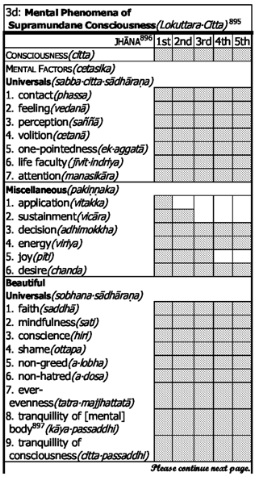
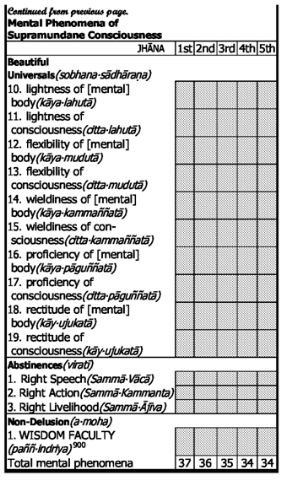
89S The table has been designed according to the combination system (satigaha’naya): all combinations of mental phenomena. (AbS.ii.36-37 ‘Lokuttam·atta·Sarigaha·Nayo'(‘Supramundane Consciousness Combination-System’) CMA.ii.19-20, and AbS.ii.33-34 ‘Sobhana·eelasika·Sampayoga·Nayo'(‘Beautiful Mental-Factor Association-System’) CMA.ii.17.)) One column is one type of consciousness, with mental factors shaded.
896 A Path Knowledge is always associated with jhana: minimum the firstjhana. See table ‘le Supramundane Resultant Consciousness’, p.339.
897 tranquillity of [mental] body/consciousness: see footnote 150, p.54. 898 latencies: see footnote 145, p.53.
899 PsM.I.v.213 ‘\I7mokkha-Katha'(‘Discussion of Uberation’) PD.I.v.31
332
The Workings of Kamma
As we progress from one Path Knowledge to another, more and more fetters, hindrances, defilements, etc. are destroyed: from the very gross to the very subtle. Eventually, absolutely all defilements are destroyed without remainder. And at the arising of the Arahant Path-Knowledge(All1hatta·Magga·~a), no defilement of any kind will ever arise again.
THE FoUR PATH KNoWLEDGES
Let us then discuss how the Path Knowledges liberate one from defilements stage by stage, until one is completely liberated from defilements at Arahantship.901
STREAM ENTRY
The first Path Knowledge, the Stream-Entry Path Knowledge (Sot·Apatti-Magga·fJfina), destroys three fetters(samyojana): the identity view(sakkaya·difthi}, scepticism(vtik.td1a), and rule&rite ad herence(S/7abbata·pariimasa). The Stream Enterer has now unshakeable faith in The Buddha, Dhamma, and Sangha, unshakeable faith in the threefold training, unshakeable faith in past lives, unshakeable faith in future lives, unshakeable faith in past and future lives, and unshakeable faith in dependent origination.902 That means the Stream Enterer is no longer able to hold a wrong view about the workings of kamma.903
Furthermore, with the arising of the Stream-Entry Path is the arising of the Noble Eightfold Path(Ai&’a Atthatigika Magga): that means there arises Right Speech(Samma vaca), Right Action(Samma Kammanta), and Right Livelihood(SaIl7fl78 Ajiva). 284 That means the Stream Enterer is no longer able to kill, to steal, to engage in sexual misconduct, to tell a lie, and is no longer able to drink beer&wine liquor. She or he is also no longer able to engage in possessiveness(maatlanya).
900 wisdom faculty: here, it is Path&Fruition KnowiedgejWisdom: the Stream-Entry-, OnceRetum-, Non-Retum-, or Arahant Path&Fruition KnowiedgejWisdom. They know Nibbana. See ‘The Five Types of Knowledge’, p.56.
901 VsM.xxii.830 ‘Pahatabba·Dhamma·Pahana.J(atl7a’ (‘Discussion of the Abandoning of the Things to Be Abandoned’) PP.xxii.64-75
902 See quotations endnotes 32, p.23, and 54, p.27. 903 See quotation endnote 51, p.27.
VI- The Unworking of Kamma
333
Such greed and hatred that can lead to an unhappy rebirth will have been destroyed: she or he is no longer able to accomplish unwholesome kamma of the kind that leads to an unhappy rebirth.
Furthermore, the Stream-Entry Path Knowledge functions as interceptive kamma to cut off all unwholesome kammas (earlier in this life, and in the infinite past) that could mature at death to produce an unhappy rebirth:904 either an unwholesome subsequently-effective kamma, or an unwholesome indefinitely-effective kamma. Such kammas will all have lapsed.
Stream Entry is not the end of the training, however. The Stream Enterer is still a trainee(sel11a),9OS and The Buddha says she or he must not rest content with Stream Entry: effort must be made in this life to attain Arahantship.285
What is the Stream Enterer’s duty? To do as before: 286 one must contemplate the five aggregates as devoid of permanence, happiness, self, and beauty. Then when one’s parami mature, one may progress to the second Path Knowledge.
If, however, one dies as a Stream Enterer(Sot·Aj7anna), only a wholesome kamma will be able to produce rebirth: either in the human world or in a heavenly world. Wherever it be, one must again contemplate the five aggregates as devoid of permanence, happiness, self, and beauty. And one will for sure attain Arahantship within seven lives, either as a human being, deva or Brahma. How soon depends on one’s effort and parami.287
ONCE-RETURN
The second Path Knowledge, the Once-Return Path Knowledge(Sakad·Agami-MaggalJana), destroys no defilements, but further weakens the fetters of sensual greed, and hatred. And the Once Returner(Sakad·AgamO will for sure attain Arahantship within two lives, either as a human being, deva, or Brahma. How soon depends on her or his effort and parami.288
Then again, be it in the human world or a heavenly world, the Once Returner’s duty is to contemplate formations as devoid of permanence, happiness, self, and beauty. Then when one’s parami mature, one may progress to the third Path Knowledge.
NON-RETURN
The third Path Knowledge, the Non-Return Path Knowledge(An·Agami-Magga·Nana), destroys any remaining sensual greed (sensual lust), and hatred, including remorse. One is no longer able to engage in sexual conduct, or slander, harsh speech, or ill-will.
The Non-Returner(An·Agami) is so called because the Non-Return Path Knowledge functions as interceptive kamma to cut off all kammas (earlier in this life, and in the infinite past) that could mature at death to produce rebirth in the sensual realm: either wholesome subsequently-effective kammas, or wholesome indefinitely-effective kammas. They will all have lapsed. The Non-Returner will never return to the human or sensual deva worlds.
At the death of a Non-Returner, only a jhana kamma will be able to produce rebirth: in the Brahma world. And he906 will for sure attain Arahantship as a
904 See quotation endnote 56, p.28.
90S See also ‘Eight Noble Individuals’, p.16.
906 Brahmas are only male: according to The Buddha, it is impossible for a Brahma to be (!I~ •• “” {uttt/ut< – page.)
334
The Workings of Kamma
Brahma in a subsequent life. How soon depends on his effort and parami.289 And again, his duty is to contemplate formations as devoid of permanence, happiness, self, and beauty. Then when his parami mature, he may progress to the fourth Path Knowledge.
ARAHANT
The fourth Path Knowledge, the Arahant Path-Knowledge(Alllhalta-Magga·Nana), destroys all greed for fine-material-(n7pa), and immaterial existence(an7pa·bhava), sloth&torpor(lf1ina·middha), conceit(mana), restlessness(uddhaao), and ignorance (avijia). One is no longer able to engage in prattle or covetousness.290 In short, the Arahant Path-Knowledge has completely destroyed greed(labha), hatred (dosa), and delusion(moha),907 completely destroyed ignorance(avijia) and craving(tanha).
As we have discussed many times now, for there to be kamma, there needs to be ignorance and craving: without ignorance and craving, there is no kamma. So the Arahant’s actions do not produce kamma: neither unwholesome kamma nor wholesome kamma; neither presently-effective-, subsequently-effective-, nor indefinitely-effective kamma. The Arahant’s volition is purely functional(kinya).
The Arahant Path-Knowledge functions as interceptive kamma to cut off any remaining kammas that could mature at death to produce any whatsoever kind of rebirth. Such kammas will all have lapsed. At the death of an Arahant, there is no rebirth: anywhere.908 Not in the sensual realm, not in the fine-material realm, not in the immaterial realm: and here we must remember that a Buddha is also an Arahant. 909
THE UNWORKING OF KAMMA
The Arahant is called a non-trainee(a·sel11a),910 meaning an adept, because she or he has completed the threefold training: morality(517a), concentration (samadhi), and wisdom/Paiiiiaj. When this training is complete, one’s mind is purified of the defilements. That is the DispensationfTeaching of Buddhas(Buddhana sasanamj.
The Buddha explains it in a verse:911
Sabbapapassa a·kara(lam, kusalassa upasampada. sa·cittapariyodapanam, etam Buddhana sasanam. All evil not doing, the wholesome acquiring,
One’s mind purifying: this is The Buddhas’ Teaching.
The Buddhas teach one to do no evil. That is morality training: it is wholesome kamma(kusala kamma). And The Buddhas teach one to purify one’s mind. That is concentration training (samatha), and wisdom training (vipassana): concentration is wholesome kamma, and wisdom is wholesome kamma. As we have now
female: see footnote 111, p.40. For why this is so, see footnote 123, p.43.
907 The Buddha explains this many times; see, for example, quotations endnotes 33, p.24, and 173, p.245.
908 See table ‘3e: Dependent Origination from Life to Life’, p.345.
909 Explaining the nine qualities of a Perfectly Self-Enlightened Buddha(5l1mmi·5l1m·&idtU1a), The Buddha gives Arahantship as the very first (e.g. D.IL3 ‘Maha·Patinibb8na·Suttam’ (‘The Great-Parinibbana Sutta’)). This quality of His is explained in VsM.vii.125-130Wuddh·Anussati'(‘Buddha Recollection’) PP.vii.4-25.
910 The uneducated ordinary person is in this classification called a neither trainee nor non-trainee(n’eva·sekf1a·n-a-sekha).
911 DhP.xiv.5 Wuddha·l-aggo’ (‘Chapter on Buddha’)
VI- The Unworking of Kamma
335
explained many times, the escape from suffering requires that one has accomplished these three types of wholesome kamma over many lives. Then, when one’s parami mature, one’s mind is purified stage by stage by the four Path Knowledges: they are the most powerful of all wholesome kammas, because they destroy all unwholesome and wholesome kammas that are able to produce rebirth. When one’s mind is purified by the ultimate Path Knowledge, the Arahant Path-Knowledge, one’s actions no longer possess any kammic potency: one’s actions are then purely functional(~a).
Thus, we may say that by accomplishing many wholesome kammas over many lives, eventually one destroys kamma.912 We may say that by the workings of wholesome kamma, one achieves the unworking of kamma.291 Then has one done what needs to be done(katam karaniyam).
912 This is why The Buddha says wholesome kamma leads to the end of kamma: see quotation endnote 88, p.234.
VI- The Unworking of Kamma
337
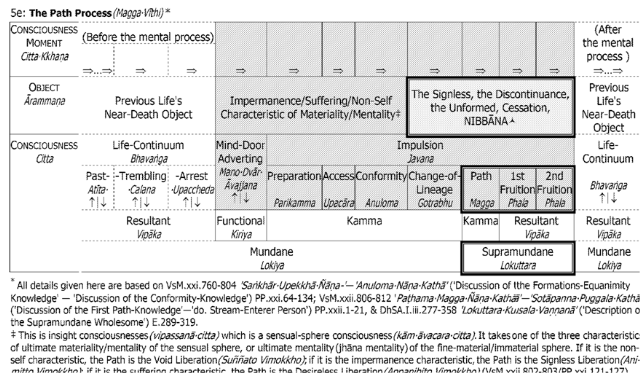
Notes for Table 5e ‘1be Path Process’
· One consciousness lasts one consciousness moment(dtta·kkhana), with three stages: arising(upp8da) t, standing(tflili) I, dissolution(bhaliga).j..
· Before and after a mental process, arises a number of Iife-continuum consciousnesses.913
· The Stream-Entry Path-Process does not arise on the immaterial plane (See explanation p.174). But the Once-Return-, Non-Return-, and Arahant PathProcess arises on either the sensual-, fine-material-, or immaterial plane.
· Cognition follows a fixed procedure, according to the natural law of the mind (dtta·niyiima). Thus, the procedure of the Path Process is:914
1) A mind-door adverting consciousness: it takes the same insight object as the preceding Formations-Equanimity Knowledge.
2-4) Three preparatory impulsions with the same object: i) Preparation(pan’Ailmma;91S
ii) Access(upaciira)
iii) Conformity Knowledge(anuloma)
Their repetition prepares the way for transition from insight knowledge with the formed as object to the Path&Fruition Knowledges with the Unformed as object. Thus they may be said to function as preparation for, access to and conformity with the Change of Lineage.
5) Change-of-Lineage Knowledge:916 it takes Nibbana as object, and marks the transition of knowledge from the ordinary-person Iineage(puthu:ijana.gott;J) to the Noble Iineage(Anya-uotta).
6) Path Knowledge:917 it takes Nibbana as object, and is the first arising of the supramundane Noble Eightfold Path in one continuity of mentalitymateriality, whereby certain defilements are destroyed: all have been destroyed with the Arahant Path. The Path Consciousness is an absorption consciousness, minimum the first jhana.918/292
7-10) Two or three Fruition Consciousnesses: they also take Nibbana as object, and are the direct result of the Path Kamma. With practice, one may enter into the fruition attainment for longer periods of time: up to seven days (See table ‘5d:The Jhana-Attainment Process’, p.176).
913 Ufe-continuum consciousness: for details, see footnote 305, p.l05, and table ‘5a:
Death and Rebirth’, p.50.
914 For a discussion on the maturing of the Formations-Equanimity Knowledge, see footnote 894, p.330. For the mental phenomena of the various process consciousnesses, see ‘Mental Phenomena of the Mind-Door Process’, p.148.
91S In one of keen faculties, the preparation consciousness does not arise: there are only three impulsions before the Change of Uneage. In that case, three Fruition Consciousnesses arise. (VsM.xxii.811/PP.xxii.16)
916 Change-of-Uneage Knowledge: it takes Nibbana as object, but is not supra mundane, because it does not destroy defilements. And in preparation to a higher path, it is called c1eansing(loI:1diina), because one is in that case already a Noble One.
917 Path Knowledge: this knowledge’s primary result is the Fruition Knowledge. The secondary result is destruction of defilements (VsM.xxii Wiina·Dassana· Visuddhi·Niddeso'(‘Exposition of the Knowiedge&Vision Purification’ PP.xxii.) See also ‘Stream Entry’, p.332.
918 For details, see table ‘le Supramundane Resultant Consciousness’, p.339.
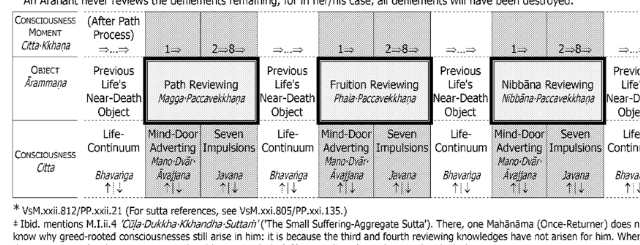
The Reviewing Knowledges*
After the Fruition Consciousnesses, there is sinking into the Iife-continuum{bhavanga). Then, in accordance with the natural law of the mind{citta·myama}, there arise the Reviewing Knowledges{paccavekkhana.fJana). That is five reviewings:
1)Path Reviewing ………………….. (MaggaPaccavekkhana) 3) Destroyed-Defilements Reviewing …. ( PahinaKilesa Paccavekkhana)
2) Fruition Reviewing ……………. (PhalaPaccavekkha(ia) 4) Remaining-Defilements Reviewing .. (AvasitthaKilesa Paccavekkha(ia)
5) Nibbana Reviewing .. (NibbanaPaccavekkha(ia)
All five reviewings follow the same procedure, although Nos.3 and 4 (destroyed- and remaining Defilements) may not take place.* An Arahant never reviews the defilements remaining, for in her/his case, all defilements will have been destroyed.
VI- The Unworking of Kamma
339
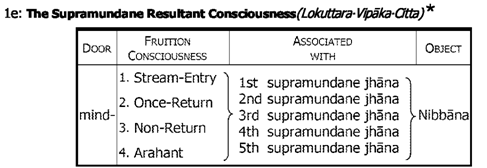
Even though they are the result of wholesome kamma, these types of resultant consciousness are never called wholesome-resultants(kusala’vipaka), since that term refers only to the unrooted wholesome resultants: see table, p.62.
FRUillON CONSCIOUSNESS: the Fruition Consciousness is the result of its corresponding and immediately preceding Path Consciousness(Magga·Cilta): for example, the Stream-Entry Path Consciousness is the supramundane wholesome consciousness, and the StreamEntry Fruition Consciousness is the corresponding supramundane resultant consciousness. See ‘The Path Process’ above.
As5oc:IATED WITH: the supra mundane resultant consciousnesses arises associated with the mental factors of one of the five jhanas.
1st supramundane jhana: if the insight knowledge’s object is a first-jhana phenomenon, the Path&Fruition are first supramundane jhana (eight-factored Path). If the object is a material phenomenon or sensual-sphere mental phenomenon, then even though the object is dissociated from any jhana factors, the Path&Fruition are associated with the five factors of the first supramundane jhana, even if one has no previous mundane jhana.
2nd supramundane jhana: if the object is a second-jhana formation, the Path&Fruition are second jhana with an only seven-factored Path, because there is no application(ldtakka) (application is a first-jhana factor, and corresponds to Right Intention(Samma Satikappa), a Path factor).
3rd/4th/5th supramundane jhana: in the same way, if the insight knowledge’s object is a third-jhana formation, the Path&Fruition are third jhana, etc.
(DhSA.i.277-358 ‘LolaJttara·Kusala· Vannana’ (‘Description of the Supramundane Wholesome’) E.289-319). See also quotation, endnote 292, p.353.
When the supramundane consciousnesses are reckoned according to the five jhanas, they make twenty supramundane wholesome consciousnesse5 and twenty supramundane resultant consciousnesses.
The Buddha ends the second ‘Gaddula’Baddha’sutta explaining how the educated Noble Disciple(sutava Aliya·savako) has done what needs to be done. Let us listen to his explanation.
DoNE Is WHAT NEEDS TO BE DoNE
You will remember how The Buddha first explained that the educated Noble Disciple practises vipassana on the eleven categories of five aggregates, regarding them according to reality and with Right Wisdom as: ‘This is not mine, I am not this, this is not my self.’ Seeing them as in this way void, the educated Noble Disciple becomes disenchanted with the five aggregates. Let us take it from there again:
Thus seeing, bhikkhllS, the educated Noble Disciple [1] with this very materiality is disenchanted;
[2] with this very feeling is disenchanted;
[3] with this very perception is disenchanted; [4] with these very formations is disenchanted;
340
The Workings of Kamma
[5] with this very consciousness is discenchanted.
· Disenchanted, he is dispassionate; dispassionate, he is liberated.
· Liberated, there is the knowledge: ‘I am liberated.’
· He knows: ‘Consumed is birth; lived is the holy life; done is what needs to be done; there is nothing further beyond this.’
In practical terms, what does it mean?919
· He is dispassionate(villljja17): here, The Buddha is referring to the Path Knowledge.
· Dispassionate, he is liberated(vim~ vimucca17): here, The Buddha is referring to the Fruition Knowledge.
· Liberated, there is the knowIedge(~a}: ‘I am liberated(vimuttam)’: here, The Buddha is referring to the Reviewing Knowledge(Paa:al<ekk/1ana·NanaJ. After the arising of the Path&Fruition Knowledges, there is always Reviewing Knowledge: reviewing what has been achieved.92o
· He knows: ‘Consumed is birth(khina jab’); lived is the holy life(vusitam Brahma·caliyam); done is what needs to be done(katam karaniyam), there is nothing further beyond this(n·8par.lm itthattiiya):921 The Buddha explains this in another way in the first ‘Gaddula·Baddha’sutta.922 There He says:
[1] He is released from materiality(pan’muccab’rOpamha); [2] he is released from feeling(pan’muccab’ l<edanaya);
[3] he is released from perception(pal#nuccab’safinaya); [4] he is released from formations(pan’muaob’saJikhiirehi);
[5] he is released from consciollSness(pan’muccab’ vifi~amha);
he is released from birth, from ageinglldeath, from sorrow, from lamentation, from pain, from displeasure, and from despair(pan’muccab’ jatiya jam·maranena sokehi pan’devehi dukkhehi domanassehi upayasehi).
‘He is released from suffering’, I dedare(Parimua:ab’dukkhasma’ti vadami).
This is Arahantship.
Is it good? Yes, it is very good! It is the best: it is the ultimate happiness(paIllma sukha).923 Buddhas arise in the world for this reason. This is why Buddhas teach The Buddhas’ most superior Dhamma teaching (Buddhanan’1 s8mukkamsikii Dhamma·desanaJ. 293 It is found only in the teaching of Fully Enlightened Buddhas. 294 It is for this They teach the Four Noble Truths.924 Because it is only by fully understanding the Four Noble Truths that one may achieve the liberation that is perpetual, not temporary(a·sama)ll’kan’1): that is, supramundane Iiberation(lokuttall7 vimokkho), the highest being the Arahant Path&Fruition Knowledges.
919 The following analysis has been taken from SA.ILLviLDlssutava·Suttam'(The “Uneducated” Sutta’).
920 See ‘The Reviewing Knowledges’, p.338.
921 DA.L2 ‘Samafifia·Phala·Suttam'(‘The Asceticism-Fruit Sutta’) explains: CONSUMED IS BIRTH: the birth that would have arisen if the the Arahant Path-Knowledge had not arisen has been consumed. LIVED IS THE HOLY LIFE whereas the good, ordinary person and the seven trainees ‘live’ the holy life, the Arahant has ‘lived’ the holy life. DONE IS WHAT NEEDS 10 BE DONE: the tasks to be done by the Path Knowledges have been done. THERE IS NOTHING RJRTHER BEYOND THIS: there is nothing further to be done with regard to developing the Path, or, there are no further aggregates beyond the present ones (see in this connection also quotation from the Sarikhar-Upapatti’sutta, endnote 59, p.36).
922 See ‘He Does Not Go Round the Five Aggregates’, p.18.
923 DhP.xv.8 ‘Sukha· Vagga’ (‘Chapter on Happiness’)
924 The Buddha’s most superior Dhamma teaching: see p.135.
VI- The Unworking of Kamma
341
We shall now ask you: what is the Arahant’s duty? To observe the Vinaya,295 to learn and teach the Dhamma as taught by The BUddha,296 so that others may learn the Dhamma taught by The Buddha, and themselves attain a Path&Fruition: 297 that is the Arahant’s duties, while she or he waits for Parinibbana.298
To prevent any misunderstandings, let us then discuss the Arahant’s Parinibbana.
THE Two TYPES OF PARINIBBANA
The Buddha speaks of two types of Parinibbana:299
1) The Nibbana element with remainder(sa·up8di.ll5§ Nibbana dhatu). here, as we mentioned before, the four Path Knowledges take the Unformed Element (Asatikhata·Dhatu) as object. Doing so, they destroy the defilements stage by stage. And with the fourth Path Knowledge (the Arahant Path-Knowledge (Arahatta-MaggalJana», there is the remainderless cessation of defilements: that is, they no longer arise, ever.92S Hence, this type of Parinibbana is also called defilements Parinibbana(kileso·Pambbana).926
With the defilements Parinibbana there is the destruction of lust(mga.kkf1ayo), the destruction of hatred(dosa·kkf1ayo), and the destruction of delusion(moha·kkf1ayo). 927 That means the five causes for future rebirth have been destroyed: ignorance, volitional formations, craving, clinging, and the existence of kammic potency have ceased to be: the Arahant’s volition is therefore only functional(kinya). 300 And all the kammas accomplished before Arahantship, which had the power or potency to produce a new existence lapse.301 But the Arahant’s aggregates have not ceased; they still remain. If the Arahant is a human being or a sensual-realm deva, there are still consciousness, mentality-materiality, the six bases (eye-, ear-, nose-, tongue-, body-, and mind base), contact, and feeling. The human Arahant still has consciousness established in the human world, in the sensual sphere, and still experiences physically painful feelings(dukkf1a·Vfdana), pleasant feelings, and neutral feelings. But because all defilements have been destroyed, she or he does not experience mentally unpleasant feelingS(domanassa·vedana).302
2) The Nibbana element without remainder(an·upadi.ll5§ Nbbana dhatu). here, the aggregates cease. Hence, this is also called aggregates Parinibbana (khandha·PaJinbbana). But if it is a human Arahant, there remains one type of materiality aggregate: temperature-born materiality(utqja·fl7pa), which is the human corpse: if the corpse is cremated, there may remain material relicS(dhatu).303
The five results that are the present rebirth have now ceased. For the Arahant of the human or sensual-realm deva, it is the remainderless cessation of consciousness, mentality-materiality, the six bases (eye-, ear-, nose-, tongue-, body-, and mind base), contact, and feeling. Here again, ‘remainderless cessation’ means no further arising. The Arahant’s decease consciousness arises, stands and perishes, and then there is no further arising of
92S This means the latencies have been destroyed: see footnote 145, p.53.
926 defilements Parinibbana: e.g. VbhA.XVLx.809 ‘Pafhama·Bala·Niddeso'(‘Exposition of the First Power’) DD.XVLx.2173. The Most Venerable Sayadaw points out that this is in fact not really Nibbana, but is explained as such by The Buddha as a method of teachingO:wlijtaya).
927 The Buddha explains it many times. See, for example, quotation endnotes 33, p.24, and 173, p.245.
342
The Workings of Kamma
consciousness. It means all suffering has ceased without remainder: physically painful feelings(dukkha·Vfdana), mentally painful feelings, pleasant feelings, and neutral feelings. The remainderless cessation of defilements and the kammic potency is the cause, and the remainderless cessation of the five agg regates is the effect.928/304
Our Buddha’s defilements Parinibbana took place at Uruvela, beside the Neraiijara River at the foot of the Bodhi Tree: there, He realized the Unformed Element, Nibbana, with His four Path&Fruition Knowledges. He lived on for forty-five years, teaching the Dhamma. Many times He suffered physical pain and discomfort, because of digestive problems. And when Devadatta caused a splinter of rock to strike The Buddha’s foot, The Buddha suffered great physical pain.929 But He endured the pain, mindful, and discerning, without suffering mental pain.93O Then, when our Buddha was eighty years old, between the two lines of sal(sala) trees in Kusinara, His aggregates Parinibbana took place.
Only with the attainment of one’s aggregates Parinibbana has one put an end to all suffering, because there is no re-arising of any aggregate: the Arahant attains Parinibbana with consciousness unestablished(apalittflila).
To prevent any misunderstandings, let us then discuss consciousness established(palittflila) and consciousness unestablished(apalittflila).
CONsaouSNESS ESTABLISHED AND UNESTABLISHED
CONSCIOUSNESS ESTABLISHED
Let us begin by repeating the beginning of the two ‘Gaddula’Baddha‘suttas:
Inconceivable is the beginning, bhikkhus, of the round of rebirth. A first point is not known of ignorance-hindered beings fettered byaaving, I1I5hing on and I1Inning about.
As we have already mentioned, The Buddha is here discussing the round of rebirth(san’lsai”a). It is the rushing on from one world to another (birth now as a human being, then a deva, then an animal, then again a human being, etc.), and the running about within one world (again and again birth as a human being, or again and again birth as a deva, etc.).
BIRTH
What is birth? It is the arising of resultant aggregates:305 they arise as the result of past kamma.931 The Buddha speaks of birth also as descent(okkanti) (descent of consciousness). 306 And He speaks of birth as consciousness established(vifiiiana patitthila), which is the same thing: the arising and establishment of the rebirth-linking consciousness(patfs”andhi·dlta). The rebirth-linking consciousness is a resultant conciousness(vipaka·dlta), and it takes as object the kamma, kamma sign(kamma·nimittiJ) or destination sign(gati·nimittiJ) cognized by the near-death process(mallln·asanna.vilf1lj of the preceding Iife.932
As we have explained before, consciousness does not (cannot) arise alone. It arises always together with the three other mental aggregates, feeling(Vfdana),
928 See table ‘3e: Dependent Origination from Life to Life’, p.345. 929 See ‘The Venerable Devadatta’, p.150.
930 S.I.IV.ii.3 ‘Sakalika·Suttam'(‘The Splinter Sutta’) 931 See ‘The Resultant Dhammas’, p.42.
932 See table ‘5a: Death and Rebirth’, p.50.
VI- The Unworking of Kamma
343
perception(saiiiia), and formations(salikllma): they are mental factorS(retasika).933/307 When a being is born in the sensual realm (the hells, the animal world, the ghost world, the human world, and the sensual-realm deva worlds), or in the fine-material realm (the Brahma world), the rebirth-linking consciousness depends on materiality(rOpa): that makes the five aggregates(pafica·kkhandha).308
FIVE-, FOUR-, AND SINGLE-CONSTITUENT EXISTENCE
In the Pali Texts,934 rebirth of a being in the sensual- and fine-material worlds is called five constituent existence/Paiial·vo\”alll·bhavo). In such a case, the rebirthlinking consciousness(patts”andhi·dtta) is established together with resultant mentality-materiality(vpaka·nama·rOpa).309
When a being is born in the immaterial world, however, the rebirth-linking consciousness is established together with only feelings, perception, and formations: there is no materiality. Therefore, such rebirth is called four-constituent existence (altlJ·vokara·bhavoj.
And when a being is reborn in the impercipient world, only matter is established. Therefore such rebirth is called single-constituent existence(eka·l17kalll·bhavo). But because the impercipient being(asafifia·satta) has not uprooted the latencies, impercipient existence is followed by re-establishment of consciousness. How? When the impercipient being’s material life faculty is cut off, in the next mind moment there is the maturing of an adventitious indefinitely-effective kamma from that being’s past: it establishes a rebirth consciousness in the human world, which is five-constituent existence.93S/310 That is how there is the establishment of consciousness (rebirth), in the three spheres of existence: the sensual-, finematerial, and immaterial sphere.
Is there rebirth anywhere else? No. The Buddha says the highest existence is rebirth in the highest plane of the immaterial sphere: the plane of neither-perception nor non-perception.936
After the rebirth consciousness is established, what happens?
933 See further ‘Things Impossible for Consciousness to Do’, p.346.
934 VsM.xvii.647 ‘Upadana·Paccaya·Bhava·Pada· Vittham.J(atl7a’ (‘Detailed Discussion of the ainging-as-cause-Existence Phase’) PP.xvii.253-255. It quotes The Buddha’s explanation in Vbh.vi.234 ‘Pa{icca·Samuppada· Vibharigo’ (‘Analysis of Dependent Origination’).
93S The impercipient being’s near-death object in the previous life is a kasilJa object, with strong revulsion for mentality. And there is rebirth of only materiality: no mentality, rebirth-, or decease consciousness, or near-death process (for details, see subsa:juent endnote 310, p.355). ‘Pafica·Ppakamna Anu· Tlka’ (‘Sub-Subcommentary of Five Expositions’) ‘Paccaya·Paccan.ijt·Anuloma·Vannana’§190 explains that this principle applies both to impercipient existence (which is always followed by sensual-sphere existence), and immaterial existence (which may be followed by another immaterial existence on the same or a higher plane), or by sensual-sphere existence. See table ‘Sa: Death and Rebirth’, p.50.
936 In M.IILi.6l4neiipsappaya·Suttam'(‘The Imperturbable-Wards Sutta’), The Buddha explains that the chief [existence-] c1inging(upid§na’~ni) is clinging to existence in the base of neither-perception nor non-perception. MA.ibid. explains that this refers to rebirth there: it being the chief and highest plane of existence. In Vbh.ibid., The Buddha speaks thus of percipient existence (all types of existence other than the next two),impercipient existence, and neither-percipient nor non-percipient existence.
344
The Workings of Kamma
THE STREAM OF CONsaOUSNESS
After the rebirth consciousness is established, the life-continuum consciousnesseS(bhavariga-dtta) arise one after the other: they take the same past object as the rebirth-linking consciousness, and are also resultant consciousnesses. The stream of Iife-continuum consciousnesses is arrested only when there arises a mental process(dtta-vilf1lj: either a five-door process(pafica-dvara-vilf1i}, or a mind-door process(mano-dvara-vilf1i). Such a mental process comprises resultant consciousnesses (vipaka-citta), functional consciousnesses(kbijta-dtta), and impulsion consciousnesses (javana). As we have discussed earlier, the impulsion consciousnesses of a nonArahant produce kamma: they are also called kamma consciousness(kamma-vinnii(la).
That way, from the beginning of a life (the rebirth-linking consciousness(patfsandhi-citta» up to the end of that life (the decease consciousness(Q/u-dtta», there is established a stream of consciousness(vbiiifina-sota). And together with each consciousness arise also the mental factors (feeling, perception, and formations), as well as materiality. We have thus consciousness, mental factors, and materiality arising and perishing one after the other like a river. 311
The last consciousness in one life is the decease consciousness(Q/u-dtta): it takes the same past object as the rebirth-linking consciousness and Iife-continuum consciousnesses, and it is also a resultant consciousness. Then, so long as one is still one of the ignorance-hindered beings fettered byaaving, the decease consciousness is followed by yet another rebirth-linking consciousness: in the very next mind moment. The stream of consciousness is not broken. It establishes itself in a new set of mentality-materiality: that is rebirth of a new ‘being’. For example, a human being’s decease consciousness arises and perishes, and then a new rebirth-linking consciousness may be established in another world, maybe the animal world or a deva world: that is I1Ishing on from one world to another. The new rebirth-linking consciousness may also be established in a new mother’s womb: that is I1Inning about within one world. 312
A being who in this way rushes on and runs about is in fact merely the establishment of a stream of consciousness. It may be established in, for example, the sensual sphere, and flow there maybe over many lives. It may be established as the mentality-materiality of a human being, and then as the mentality-materiality of a deva, etc. Then maybe it stops flowing in the sensual sphere, and establishes itself in the fine-material sphere, flowing there for many lives too. Again, it may stop flowing in that sphere, and continue flowing in the human world again, etc. 313
The two main causes for the establishment of consciousness are ignorance (al1ii8)and craving(tanha). Without ignorance and craving, the kammic potency (kamma-satti) cannot establish consciousness in any sphere. We have discussed this many times.
With the Arahant Path-Knowledge, there is the remainderless cessation of ignorance and craving. That means ignorance and craving will never arise again: it is the defilements Parinibbana(b’leso-Pan’nibbana). With the remainderless cessation of ignorance and craving, the kammic potency of present volition ceases to be: we may say it is the complete unworking of present kamma. But the kammic potency of past kamma still works, which means the Arahant’s stream of consciousness continues, and consciousness is still established. Consciousness is no longer established, however, in the production of kamma.314 The impulsion consciousnesses that arise no longer produce kamma: the Arahant’s volition is purely functional.
VI- The Unworking of Kamma
345
CONSCIOUSNESS UNESTABLISHED
Then we shall ask you a question. If ignorance and craving are the reason why consciousness is established in one of three realms again and again; if ignorance and craving are why a being is reborn again and again (now here, now there), what happens when ignorance and craving have been destroyed? What happens when the cause for consciousness’s establishment has been destroyed?
It is very easy: when the cause for consciousness’s establishment has been destroyed, consciousness is not established: when consciousness is not established, it is unestablished(appatilthita).937
At the dissolution of the Arahant’s decease consciousness (at the Arahant’s death), the stream of consciousness is unestablished in this world or another world.938It is the complete unworking of kamma past, present, and future.
At the Arahant’s death, there is no further flow of consciousness: that is the aggregates Parinibbana(khandhapan’nibbana).939 As The Buddha says at the end of the second ‘Gaddula’Baddha’sutta, the Noble Disciple knows: Consumed is birth (khinii j8ti). 940/315
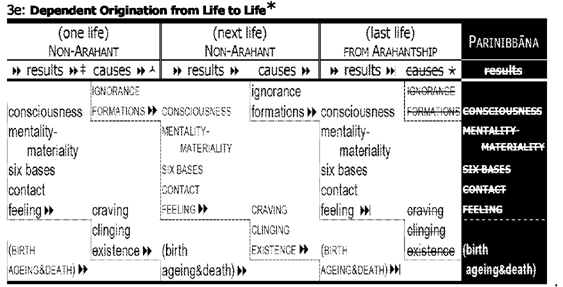
* E.g. A.IILILii.l TItth·Ayatana·Suttam'(‘The Sectarian Doctrines Sutta’ quoted p.l07). Here, The Buddha teaches in two ways: according to custom(vohim·desani), and according to ultimate truth(pBmm·attha-desani). Birth/ageing&death are according to custom. They correspond to the five factors consciousness /mentality-materiality/six bases/contact/feeling, which are according to ultimate truth. For the process going from life to life, see, for example, The Buddha’s explanation, endnote 313.
937 unestablished consciousness: see quotation, endnote 324, p.357. 938 See endnote 311, p.355.
939 VsM.xxii.836 ‘Pahiitabba·Dhamma·Pahiina·Kathii’ (‘Discussion of the Abandoning of the Things to Be Abandoned’) PP.xxii.88 explains: ‘ … the clansman disenchanted with the occurrence of the aggregates undertakes to develop the four Paths in his own continuity …. Then his aggregates-continuity(kMndha-pavattiyani) is rendered incapable of prolonging the continuity to a subsequent existence. It is now unproductive of future existence since all the kinds of kamma beginning with bodily kamma are now merely functional…. Being without clinging, he inevitably attains with the cessation of the last consciousness the complete Nibbana, like a fire with no more fuel.’
940 See table ‘3e: Dependent Origination from Ufe to Ufe’, p.345.
346
The Workings of Kamma
* Results in the life of both a non-Arahant and Arahant: kamma formations in a past life result in the arising of a rebirth consciousness, and subsequent consciousnesse5 in that life, and the simultaneous arising of mentality-materiality, the six bases, contact, and feeling. In D.ii.2 ‘Maha·Nidana·Suttam'(‘The Great Causation Sutta’), The Buddha explains that in one life one can go only as far back as the arising of mentality-materiality and consciousness at rebirth: ‘Thus far the round [of rebirth] goes as much as can be discerned in this life, namely to mentality-materiality together with consciousness.’
A Causes in non-Arahant’s life: the non-Arahant is possessed of ignorance. Hence, when there is feeling, there is craving, and clinging, owing to which there is existence of the kammic potency, formations of kamma. This means there is at death the arising of a rebirth consciousness.
* Causes in Arahant’s life: because there is no ignorance, there is no craving, and no clinging, which means there is no further existence of the kammic potency, no formations of kamma. This means there is at death no arising of a rebirth consciousness. Until then, the five results are still in operation.
No ESTABLISHMENT IN NIBBANA
Then we may think the Arahant’s stream of consciousness is established in Nibbana. But that is impossible. Why? Because
· according to the Buddha’s Teaching Nibbana is devoid of five-constituent existence, four-constituent existence, and single-constituent existence;
· according to the Buddha’s Teaching, Nibbana is devoid of coming, going, and staying, and devoid of rebirth and decease. 316
· according to the Buddha’s Teaching, in Nibbana the four great essentials are unestablished, and mentality as well as materiality completely stOpS(as-esan7 UpallIjjhati).317 It is the cessation of the world(loka·nirodha), which is the nonarising of the five aggregates, non-arising of the six internal and external bases, etc. 318
THINGS IMPOSSIBLE FOR CONSCIOUSNESS TO Do
Now, it is important not to get a wrong view about this: please understand that consciousness unestablished does not mean that consciousness exists without being established anywhere; it does not mean that Nibbana is unformed consciousness, awareness or mind; it does not mean that Nibbana is unconditioned consciousness or unconditioned awareness, unconditioned mind, pure consciousness or awareness independent of an object. According to the Buddha’s Teaching, such a thing does not exist.
Let us summarize the things that, according to the Buddha’s Teaching, are impossible for consciousness to do:
· According to The Buddha’s Teaching, it is impossible for consciousness to arise without an object, independently of an object, independently of causes; it is impossible for consciousness to be unconditioned; it arises dependent upon an internal base (eye-, ear-, nose-, tongue-, body-, or mind base),and an external base (sight-, sound-, odour-, f1avour-, tangible-, or dhamma base).319
· According to The Buddha’s Teaching, it is impossible for consciousness to arise alone; it arises always with associated mental factors.941
941 See quotation endnote 307, p.354.
VI- The Unworking of Kamma
347
· According to The Buddha’s Teaching, it is impossible for consciousness to be permanent; it is formed(5ClJikhata), and has therefore an arising stage, a standing stage, and a dissolution stage. 320
· According to The Buddha’s Teaching, it is impossible for consciousness to be Nibbana, for consciousness is possessed of the three characteristics: impermanence, suffering, and non-self. While Nibbana is also non-self, it is not possessed of impermanence, or suffering.942 Consciousness is one of the five aggregates, the Noble Truth of Suffering.321 Thus, Nibbana cannot be consciousness, for Nibbana is the Noble Truth of the Cessation of Suffering.322
When we remember these simple facts about consciousness, it is not difficult to understand that when The Buddha says the Arahant passes away with consciousness unestablished, it means consciousness no longer arises.943
Please remember what The Buddha says about the Arahant bhikkhu in the first
‘Gaddula’Baddha’sutta:944
[1] He is released from materiality(palimuaab’rOpamhiiJ; [2] he is released from feeling(pamnucrab’ vedaniiyaJ;
[3] he is released from perception(pan’muaab’safifiiiyaJ; [4] he is released from formations/Pan’muaab’ 5ClJikhiirehi);
[5] he is released from consciousness(pan’muaab’vififiiinamhaJ;
he is released from birth, from ageinglldeath, from sorrow, from lamentation, from pain, from displeasure, and from despair.
‘He is released from suffering’, I declare.
WHERE DoES lHE ARAHANT Go?
In this connection, a common question regarding the Arahant is: Where does the Arahant go after her or his Parinibbana?’ What is her or his destination?’ Then we shall ask you another question: if you light a candle, there is a flame. When the candle has burned down, where does the flame go? What is your answer? It goes nowhere: the wax and the wick burned up and the flame expired. There is no going anywhere: the Arahant does not go anywhere.323
When we say a Buddha or other Arahant ‘enters into Parinibbana’, it does not mean they enter into a place: it is a figure of speech. Just as we say, ‘I went to sleep’, it does not mean we went anywhere. The Arahant’s Parinibbana does not mean she or he goes anywhere. The Arahant’s Parinibbana means there is no re-arising of consciousness after the dissolution of the decease consciousness: consciousness is unestablished.324 That is why The Buddha says of the Arahant:94s
Ayam, bhikkhave, bhikkhu na katthaci upapajjati. This bhikkhu, bhikkhllS, is not anywhere reborn.
Mara does not know the Arahant’s coming and going, because Mara cannot see where the rebirth consciousness has been established, because it has nowhere been established.325 We may, for example, look for a certain word on a page. But if that word has not been written on that page, we cannot see it, can we?
Please remember the last stanza of the ‘l?atana’sutta: we quoted it earlier.
When The Buddha was reciting the’l?atana’sutta, a lamp near Him expired. And in the last line of the sutta, The Buddha compared Arahants to such an expired
942 See quotation endnote 270, p.350.
943 See table ‘3e: Dependent Origination from Ufe to Ufe’, p.345. 944 Quoted at ‘He Does Not Go Round the Five Aggregates’, p.18.
94S M.IILii.l0 ‘Sarikhiir·/Jpapatti·Suttam’ (‘The Formations-Rebirth Sutta’)
348
The Workings of Kamma
lamp(pad”gJO). He said:946
Nibbanti dhTra yath·ayam padipa. Steadfast, they expire as this lamp.
CONCLUSION
We hope that by this explanation there is no doubt about consciousness unestablished. If any doubt remains, please allow us to suggest that you see it all with your own direct knowledge. First undertake morality(sDa). Then develop concentration(samadhlj, until your mind is full of bright, brilliant, and radiant light of wisdom. Then use that light of wisdom systematically to practise materiality meditation (rOpa-kammatfMna) and mentality meditation(naina·kammatfMna).
When it is complete, you will have attained the Mentality-Materiality Definition Knowledge(Nama·ROpa·PaJicchedalJana). Then discern dependent origination, and attain the Cause-Apprehending Knowledge(Pacraya·Paliggaha·N8(1a).947 With that knowledge, you will have overcome all and any doubt about the establishment of consciousness in the three realms: that is why it is called Doubt-Overcoming Purification(KaliW· V”tliJrana· Visuddhi).326
If you then practise vipassana on the five aggregates of past, future, and present, internal and external, gross and subtle, inferior and superior, far and near, your parami may mature, and you will attain a Path&Fruition. Then continue practising until you attain Arahantship: the defilements Parinibbana.
Then at the end of that life, you will attain the aggregates Parinibbana. Then will you know for yourself the true meaning of ‘consciousness unestablished’.
JuST AS, BHIKKHUS, A loTUS, BLuE, RED, OR WHITE
So long as your Arahant consciousness is yet established, you may abide in the world like a lotus. Do you know what it means to abide in the world like a lotus? Please listen to The Buddha explain a Buddha’s or other Arahant’s abiding in the world:948
JIISt as, bhikkhllS, a 1ot1lS, blue, red, or white, though born in the water, [and] grown up in the water, when it reaches the surface, it stands there unwetted by the water.
Just so, bhikkhllS, though born in the world, [and] grown up in the world, having overcome the world, the Tathiigata327 abides unwetted by the world.
Do you want to be like a lotus? Now you know what to do.
The very first thing for you to do is to develop strong and powerful faith949 in the workings of kamma as explained by The Buddha. With that faith and understanding, you may then accomplish superior wholesome kammas. With the working of those kammas, you may eventually attain the unworking of kamma.
May you accomplish the unworking of kamma as soon as possible.
May you attain consciousness unestablished as soon as possible.
May you become like a lotus as soon as possible.
946 The last stanza of the ‘Ratana’sutta is quoted on p.152.
947 These knowledges are explained under ‘The Two Preparatory Insight Knowledges’, p.88.
948 S.IILLx.2 ‘Puppha·Suttam'(‘The Flower Sutta’)
949 Faith(sadtU1a) is the first of the five faculties(1nd$1).
VI- The Unworking of Kamma
349
ENDNOlES OiAPTER VI (surrA REFERENCES ETC.)
257 See also, for example, S.IILI.iL4’Yad·Ania”a·Suttam'(‘The What-is-Impermanent Sutta’): ‘Materiality [feeling, etc.], bhikkhus, is impermanent. What is impermanent it is suffering. What is suffering is non-self.’ Mentioned VsM.ibid./PP.xxL7.
258 These are the three types of suffering discussed by The Buddha in S.V.LviL5 ‘Dukkhata·Suttam'(‘The Sufferings Sutta’): discussed also at ‘Insight Meditation’, p.86.
259 In S.IILLLl ‘Nakulapita·Suttam'(‘The Nakulapita Sutta’), the Buddha explains that the only reason one might say one’s body was healthy is foolishness(M4’ani).
250 The Buddha discusses this aspect of the five aggregates in, for example, his discussion with the philosopher Saccaka in M.I.iv.5’COla·Saccaka·Suttam'(‘The Small Saccaka Sutta’). 251 The Buddha explains this in, for example, S.IILI.iiL8 ‘Abhinandana·Suttam'(‘The “De_ lighting” Sutta’): ‘Whoever, bhikkhus, delights in materiality [etc.], he delights in suffering.’ Z52 In M.I.iv.5 Wla·Saccaka·Suttam’ (‘The Small Saccaka Sutta’), The Buddha asks the philosopher Saccaka: ‘What do you think, Aggivessana? When one sticks to suffering, turns to suffering, cleaves to suffering, and regards suffering as ”This is mine, this am I, this is my self’, could one ever comprehend suffering, or dwell with suffering having been fully exhausted?’ ‘How could one, Gotama, Sir? Indeed not, Gotama, Sir.’ Saccaka is mentioned also at endnote 186, p.247.
Z63The Buddha explains this in, for example, S.IILI.iiL9 Vppada·Suttam'(‘The “Arising” Sutta’): ‘Whatever, bhikkhus, arising, standing, regeneration, and manifestaton of materiality [etc.] is the arising of suffering, the standing of disease, and the manifestation of ageing&cleath.’ See also the Buddha’s analysis of the First Noble Truth in D.iL9 ‘Maha·Sati·Pat!hana·Suttam’ (‘The Great Mindfulness-Foundation Sutta’).
254 In ItLIII.iL2 ‘Cakkhu·Suttam'(‘The Eye Sutta’), The Buddha explains: ‘Three, bhikkhus, are the eyes. What three? The fleshly eye, the divine eye, the wisdom eye.’
Z55 The Buddha explains this in, for example, A.VI.x.7 ‘Anavatthita·Suttam’ (‘The “Unstable” Sutta’): ‘By having seen six advantages, bhikkhus, it is enough for a bhikkhu to establish the perception of impermanence(anica1·.!Qfiiij”) in all formations without restriction. What six? “[1] All formations will appear unstable to me, [2] and nothing in the whole world will my mind find pleasure in, [3] and my mind will rise above the whole world, [4] and my mind will become inclined towards Nibbana, [5] and my fetters will tend towards abandonment, [6] and I shall become possessed of the supreme state of an ascetic(.sa-maiNia).”’
256 In A.X.I.iiL91’athama·Kasala·Suttam'(‘The First Kosala Sutta’), The Buddha explains that the Noble Disciple sees how King Pasenadi of Kosala, the highest human being changes; sees how the different kinds of sensual-realm devas change; sees how the different kinds of fine-material devas change; sees how the different kinds of immaterialrealm beings change; and sees how also very skilful meditators change. Seeing how all these high beings change, the Noble Disciple becomes disenchanted with the high, let alone the low, and develops insight as explained here.
257The Buddha uses the simile of the eleven fires in Vin.Mv.L12 VlUve/a·P8tihatiya-Katha’ (‘Discusssion of the Uruvela Miracles’), and S.IV.I.iiL6 ‘Aditta·Suttam’ (‘The “Burning” Sutta’). And in S.V.XILv.3’Maha·Pari./aha·Suttam'(‘The Great-Conflagration Sutta’), He explains that those ascetics and Brahmins who do not understand the Four Noble Truths delight in and accomplish kamma that leads to birth, ageing, death, etc. Having done so, they are then burned by those eleven conflagrations.
Z68These three metaphors are referred to in VsM.ibid. The Buddha uses them in M.II.iL4 ‘Maha-Malukya·Suttam'(‘The Great Malukya Sutta’), when He explains how the bhikkhu develop the fine-material-, and immaterial jhanas, and then practises vipassana on the materiality and mentality associated with them. He then becomes disenchanted with them, and progresses as explained here. Also, throughout His Teachings, The Buddha speaks of the gratification, danger of, and escape from sensual pleasure, the elements, and the five aggregates. For example, in S.IILI.iiL5l4ss8da·Suttam'(‘The Enjoyment Sutta’), He ex-
350
The Workings of Kamma
plains: ‘Whatever happiness and pleasure arises dependent on materiality [etc.]: this is enjoyment of materiality [etc.]. Any materiality [etc.] is impermanent, suffering, a changing thing: this is the danger in materiality [etc.]. The abandonment of desire and lust, the removal of desire and lust for materiality: this is the escape from materiality.’ And in the following sutta, He explains that so long as He did not directly know the enjoyment, danger and escape from the five aggregates, so long did He not claim to be enlightened. See also endnote 272, p.350.
269 The Buddha explains this in, for example, A.VI.x.8Vkkhittasika·Suttam'(‘The RaisedSword Sutta’): ‘By having seen six advantages, bhikkhus, it is enough for a bhikkhu to establish the perception of suffering(cW~..safiiii) in all formations without restriction. What six? “[1] The disenchantment perception(mbbida..safiiii) towards all formations will be established in me, in the same way as towards an executioner with raised sword, [2] and my mind will rise above the whole world, [3] and I shall become one who regards Nibbana as Peace (Santa), [4] and my latencies will tend towards uprooting, [5] and I shall become one who has fulfilled his duty, [6] and I shall have attended to the Teacher (!iat:IM) with lovingkindness practice.”’ See also quotation, endnote 272, p.350.
270 In A.IILL v .7-8 ‘Sarikhata [-A ·Sarikhata j-Lakkhana·Suttam’ (‘The Formed [-Unformed] Characteristic Sutta’, The Buddha explains: ‘Three, bhikkhus, are the formed characteristics of the formed. What three? Arising is known, perishing is known, change in standing is known.’ – ‘ … the unformed characteristics of the Unformed … Arising is not known, perishing is not known, change in standing is not known.’ See also quotation endnote 34, p.24. 271 The Buddha explains these four perversions in A.IV.Lv.9 ‘VipaIJasa·Suttam'(‘The Perversion Sutta’): ‘Four, bhikkhus, are these perversions of perception … of consciousness … of view. What four? [1] In the impermanent there is permanence …. [2] In suffering there is happiness. [3] In non-selfthere is self …. [4] In the foul there is beauty.’
272 In M.Liii.6 ‘Pasa·Rasi·Suttam’ (‘The Mass of Snares Sutta’) (also called ‘Ariya·Pariyesana·Suttam'(‘The Noble-Search Sutta’)), The Buddha describes this as the ignoble search(an‘ariya pariyesana): ‘And what, bhikkhus, is the ignoble search? Here, one himself a born thing, seeks that which is also born; himself an ageing … ailing … mortal… sorrowing … defiled thing, seeks that which is also ageing … defiled thing.’ And He explains the object of the ignoble search: ‘wife and children, men and women slaves, goats and sheep, fowl and pigs, elephants and cattle, horses and mares, gold and silver.’ The Noble Search, on the other hand, He explains as one who, having understood the danger (Wnava) in those things, seeks the Unborn, Unageing, Unailing, Deathless, Sorrowless, Unsurpassable safety from bondage, Nibbana. See in this connection further ‘The Danger of the Workings of Kamma’, p.325. 273 This is one of the many ways The Buddha says one should regard the five aggregates in M.ILii.4?11aha-Malukya·Suttam'(The Great Malukya Sutta’): see further endnote 268, p.349.
274 In S.ILI.ii.5 ‘Kaccanagotta·Suttam'(‘The Kaccanagotta Sutta’), The Buddha explains that all wrong views can be grouped into two: “‘All exists”, Kaccana, this is one extreme. “All does not exist”, this is the second extreme.’ He then teaches the middle way, which is dependent origination.
275 The Buddha explains the existent and non-existent in, for example, S.IILLx.2 ‘Puppha·Suttam'(‘The Flower Sutta’): ‘Matter [etc.] that is permanent, stable, eternal, not subject to change: this the wise in the world agree upon as not existing, and I too say that it does not exist…. Matter [etc.] that is impermanent, suffering, and subject to change: this the wise in the world agree upon as existing, and I too say that it exists.’
276 The Buddha explains the world in, e.g. S.N.Lviii.9 ‘Loka·Pafiha·Suttam'(‘The WorldQuestion Sutta’): ‘The eye, bhikkhu, is crumbling, sights are crumbling, eye consciousness is crumbling, eye contact is crumbling, and whatever feeling (either painful or pleasant or neither·painful·nor·pleasant) arises with eye contact as cause, that too is crumbling … the ear … tongue … body … mind …. It is crumbling, bhikkhu, that is why it is called the world.’ 277The Buddha explains this in, A.VI.x.9’A·Tammaya·Suttam'(‘The “Unconcerned” Sutta’): ‘By having seen six advantages, bhikkhus, it is enough for a bhikkhu to establish the per-
VI- The Unworking of Kamma
351
ception of impermanence(ania”a·.saiUii) in all formations without restriction.What six? “[1] I shall be unconcerned about the whole world, [2] and ‘I’-makings will stop in me, [3] and ‘Mine’-makings will stop in me, [4] and I shall become possessed of extraordinary knowledge, [5] the root (heI1J) will be become clearly known to me, [6] and the things arisen with the root.”’
278 He was a pupil of King Pasenadi’s chaplain Bavari. Bavari was too old to go and see The Buddha, and sent sixteen of his students to see the Buddha and ask questions, including Mogharaja.
279 In DhP.xiii.4 Zoka· Vagga'(‘Chapter on the World’), The Buddha says this in connection with two of the similes just mentioned: ‘As a bubble seen, as a mirage seen, one who regards the world in this way, the king of death does not see.’
280 Describing the Arahant in M.I.iii.2 ‘Alagadd·Upama·Suttam’ (‘The Snake Simile Sutta’), The Buddha explains: ‘The bhikkhu with thus liberated mind, bhikkhus, the devas with Inda, with Brahma, and with Pajapati”, seeking, do not find: “Dependent on this is the tatf7agatas [Arahant’s] consciousness.” What is the reason? Right then, bhikkhus, the tatf7agata is unknowable, I declare.’ The commentary explains that the devas are unable to discover the object of his insight consciousness, and Path&Fruition consciousnesses.
281 In A.VILv.6 ‘Dutiya·Safifia·Suttam'(The Second Perception Sutta’), The Buddha explains how proper development of the perception of foulness(asub’1a·.safiM) counters thoughts of sexual intercourse(metf1una-dharnma); that of death (matal}a·.safiM) counters attachment to Iife(;tvita’nikanti), that of the repulsiveness of food(aMre patikiila·.saiUii) counters craving for taste(msa·ta(lM); that of discontent with the whole world(.sabba·loke anabhitata·.safiM) (AA.ibid.: sensual-/fine-material-/immaterial world) counters thoughts of the ‘wonderful’ world(Ioka-citl/!su); and that of impermanence(ania”a·.saiUii) counters thoughts of gain, honour, and fame(I3b’1a·.sakk3ra·siloka). In each case, He explains that when the perception is properly developed, then, just as a bird’s feather or a piece of sinew thrown on a fire retreats, retracts, and recoils, so too one’s mind retreats, retracts, and recoils from the object, giving rise either to equanimity(~) or disgust/P8t7ku4eta). And for each He adds that it is of great fruit and benefit, is related to the Deathless(Amat’ogadha), and terminates in the Deathless(Amata~na). This passage is partly quoted in VsM.ibid.766/PP.xxi.63. For an example of this practice, see ‘Mara Diisi’, p.198.
Z82 In A.IV. V.iv.2 VIttI7ara·Suttam’ (‘The Detailed Sutta’), The Buddha speaks of four types of kamma, using the metaphor of black/White: 1) one accomplishes harmful kamma, is reborn in a harmful world, and experiences harmful contacts and feelings, as beings do in hell = black kamma with a black result; 2) one accomplishes harmless kamma, is reborn in a harmless world, and experiences harmless contacts and feelings, as beings do in the Brahma world = white kamma with a white result; 3) one accomplishes harmful&harmless kamma, is reborn in a harmful&harmless world, and experiences harmful &harmless contacts and feelings, as beings do in the human world, some deva worlds, and some lower beings = black&white kamma with a black&white result; 4) one accomplishes the volition (AA = Path Volition(magga·retana)) to abandon black, white and b1ack&white kamma and its result, which leads to the destruction of kamma(karnma·kkhaya) = non-black&non-white kamma with non-black&non-white results. See also the Buddha’s explanations endnotes 300, p.354, 315, p.356, and His simile of the seeds planted in a field, endnote 237, p.252. Z83 In M.III.iii.2 ‘Maha·Sufifiata·Suttam’ (‘The Great Voidness Sutta’), The Buddha explains that a bhikkhu who enjoys company with other bhikkhus is neither capable of ever entering into the mind-liberation that is temporary(S§ma.wXa) nor the one that is not temporary (a·sama.wXa).
284 The Venerable Ananda explains it in M.ILi.3 :5ekha·Suttam'(‘The Trainee Sutta’): ‘Here, Mahanama, a Noble Disciple is moral, by the Patimokkha restraint restrained he lives, possessed of conduct and resort, in the slightest fault seeing danger, undertaking to train in the training precepts. That is how, Mahanama, a Noble Disciple is possessed of morality.’ And in A.VIII.ii.9 ‘Paharada·Suttam'(‘The Paharada Sutta’), The Buddha explains how the Noble Disciple never transgresses any precept He has laid down: ‘Whatever precept has by
352
The Workings of Kamma
Me been made known to my disciples, that they do not transgress even for life’s sake.’ Further, in A.VIII.iv.9l4bhi.sanda·Suttam'(‘The Row Sutta’), The Buddha explains: ‘Here, bhikkhus, a Noble Disciple abandons killing, abstains from killing … theft … sexual misconduct … lies … he abstains from beer&wine liquor, which is a foundation for carelessness, [as he does so] he gives to countless beings safety … friendliness … benevolence.’
285 In M.Liii.9 ?I1aha·sar·Opama·Suttam'(‘The Great Heartwood-Simile Sutta’), The Buddha explains: ‘So this holy life, bhikkhus, does not have gain, honour, and renown for its benefit, nor the attainment of virtue for its benefit, nor the attainment of concentration(.samidhlj for its benefit, nor knowledge and vision for its benefit. But it is this unshakeable liberation of mind that is the goal, bhikkhus, of this holy life, its heartwood, its end.’
286 In S.IILLxii.l0 ‘SiIavanta·Suttam'(‘The “Virtuous” Sutta’), the Venerable 5ariputta explains that the virtuous bhikkhu must attend carefully to the five aggregates as impermanent, suffering, a disease, etc. Doing so, he may attain Stream Entry. And the Stream Enterer, Once Returner, and Non-Returner must each do the same to attain their next Path. Even the Arahant, he says, should do so, although there is nothing he needs to do, for it leads to a pleasant dwelling in this life (the fruition-/cessation attainment, both which require preceding vipassana practice).
286 In S.V.IV.iii.45a·Sgl·Suttam'(‘The One-Seeder Sutta’), The Buddha explains three types of Stream Enterer: 1) one attains Arahantship at the end of seven rebirths in the human and heavenly worlds; 2) one does so at the end of two to six rebirths in a good family; 3) one does so after only one rebirth in the human or heavenly worlds (explained also in, e.g. A.IILILiv.7 ‘Dutiya·Sikkha·Suttam'(‘The Second Training Sutta’)).
VbhA.xviii.l028l4yu·Ppamanam'(‘Lifespan Reckoning’) DD.xviii.2594-2596 further explains that the Stream Enterer/Once Returner reborn in the fine-material or immaterial sphere does not return to the sensual sphere, and is called a Jhana Non-Returner(.7Mna·An·Agamino). The jhana plane attained depends on the jhana most familiartPaguQa), one’s aspirationO:attf1ana), or any other jhana attained at the time of death(malaQa..samaye).
288 Once Returner: there are five types: 1) a human being attains the Once-Return Path& Fruition, and attains Arahantship in the next life as a human being; 2) a human being attains the Path&Fruition, and attains Arahantship in the next life as a heavenly being; 3) a heavenly being attains the Path&Fruition, and attains Arahantship in the next life as a heavenly being; 4)a heavenly being attains the Path&Fruition, and attains Arahantship in the next life as a human being; 5) a human being attains the Path&Fruition, passes the next life as a heavenly being, and attains Arahantship only in the subsequent life as a human being. (PuPA.ii.34 5aka·Niddesa· Vannana’ (‘Description of the First Exposition’) & VsMT.xxii.814 Tatiya-Magga·Nana-Katha· Vannana’ (‘Description of the Discussion of the Third Path Knowledge’)). But when The Buddha speaks of a Once Returner, usually He means one who returns to human existence: No.5 above. See also explanation from VbhA in previous endnote.
289 Non-Returner: all are reborn in the fine-material sphere (the Brahma world). There are five types: 1) one attains Arahantship halfway through that Brahma life; 2) one attains Arahantship in the second half of that Brahma life, even on the point of death; 3) one attains Arahantship without exertion; 4) one attains Arahantship with exertion; 5) one passes from one Brahma world to another, living out the whole life span (from a third of an aeon up to 16,000 aeons: each time, it is a jhana kamma in the one life that functions as subsequently-effective productive kamma to give him his next Brahma rebirth), and reaching the highest of the five pure abodes, the Akanitfha world. There he attains Arahantship (S.V.IV.iii.4 etc., as endnote 287, p.352).
VbhA.xviii.l028l4yu·Ppamanam'(‘Lifespan Reckoning’) DD.xviii.2593 further explains that one who attains Non-Return in the sensual deva world does not remain, but takes a fine-material existence: because there is no other suitable place for one without sensual desire. See also endnote 295, p.353.
VI- The Unworking of Kamma
353
In D.ii.l ‘Maha·Padana·Suttam’ (‘The Great-Lineage Sutta’), The Buddha speaks of visiting the pure abodes, and being told by many thousand Non-Returners still abiding there of the past Buddha’s dispensation during which they attained their Path&Fruition.
290 In D.iii.6 ‘Pasadika Sutta’ (‘Delightful Sutta’), The Buddha explains nine things that the Arahant is incapable of doing: 1) killing, 2) stealing, 3) incelibacy, 4) lying,S) storing up things for sensual pleasure like a householder, 6) doing something out of desire, 7) out of hatred, 8) out of delusion, 9) out of fear.
291 Thus, The Buddha explains that kamma with the three wholesome roots leads to the ending of kamma: see quotation, endnote 88, p.234. In A.N.N.i.9 ‘BhikkhunJ.Suttam'(‘The Bhikkhuni Sutta’), the Venerable Ananda explains how craving(taQhi) to attain Arahantship overcomes craving. And in S.V.VILii.5 Vnnabha·erahmana·Suttam'(The UlJlJabha Sutta’), he explains how desire(cMnda) to attain Arahantship overcomes desire. (For details in this regard,see footnote 595, p.203.)
292In M.IILv.7’Maha·Saf-Ayatanika·Suttam'(‘The Great Sixfold-Base Sutta’), The Buddha explains that when the Noble Eightfold Path arises, These two things occur concurrently yoked: samatha [Right Concentration] and vipassana [Right View].’ The commentary explains that they arise at the same time.
293The Buddha explains it in, for example, M.Liv.5~la·Saa:aka·Suttam'(‘The Small Saccaka Sutta’): ‘Attained to Nibbana is the Blessed One: He teaches the Dhamma for attaining to Nibbana.’
294 The Buddha explains it in, for example, D.ii.3 ‘Maha·Parinibbana·Suttam’ (The GreatParinibbana Sutta’)) ‘In whatever Dhamma and Vinaya the Noble Eightfold Path is not found, there no [one] ascetic is found. There no second ascetic is found. There no third ascetic is found. There no fourth ascetic is found.’ See also quotation, endnote 39, p.24. 295 In M.ILiii.l ‘re· Vfjja· Vacchagotta·Suttam'(‘The Triple-Science Vacchagotta Sutta’), The Buddha explains that a lay-arahant must either ordain or attain Parinibbana: ‘Vaccha, there is no householder who, without abandoning the fetter of householdership, on the breakup of the body has made an end of suffering.’ VbhA.xviii.l028 ‘Ayu·Ppamanam’ (‘Lifespan-Reckoning’) DD.xviii.2593 also explains that since the sensual-sphere deva world is unsuitable for an Arahant(and since a deva cannot become a bhikkhuni/bhikkhu), the sensual-sphere deva who attains Arahantship attains Parinibbana at the same time. 296 The Buddha explains this in D.ii.3 ‘Maha·Parinibbana·Suttam’ (‘The Great-Parinibbana Sutta’): ‘The Four Foundations of Mindfulness, the Four Right Efforts, the Four Bases of Success, the Five Faculties, the Five Powers, the Seven Factors of Enlightenment, the Noble Eightfold Path. These, bhikkhus, are the things of which I have direct knowledge and have taught, which you should learn well, cultivate, develop, practise much, so that this holy Iife(mhma’Q1$1) is established, and long endures, for the many’s welfare, for the many’s happiness, out of compassion for the world, for the benefit, well being, and happiness of devas and human beings.’ These things are also called the Thirty-Seven Requisites of Enlightenment(Satta· Tirhsa·Bodhi·Pakkhiya·Dhamma).
297 In D.ii.3 ‘Maha·Patinibbana·Suttam’ (The Great-Parinibbana Sutta’), The Buddha explains to a wanderer: ‘And if, Subhadda, bhikkhus were to rightly to dwell(.samma vihareyyuth), the world would not be void of Arahants.’ The commentary explains that ‘rightly to dwell’ means the Stream Enterer teaches others how to attain the Stream-Entry Path& Fruition, the Once Returner teaches others to how to attain the Once-Return Path&Fruition, etc. And the one who is as yet only practising samatha and vipassana for the attainment of a Path&Fruition should teach that. Also in Vin.Mv.L8 ‘Mara Katha'(‘Mara Discussion’), The Buddha says to His first sixty Arahant Disciples: ‘Freed am I, bhikkhus, from all snares, both divine and human. And you too, bhikkhus, are freed from all snares, both divine and human. Wander, bhikkhus, for the many’s welfare, for the many’s happiness, out of compassion for the world, for the benefit, well being, and happiness of devas and men. Let not any of you go together. Teach, bhikkhus, the Dhamma, which in the beginning is lovely, in the middle is lovely, and in the end is lovely.’
354
The Workings of Kamma
25l!/ The Venerable 5ariputta explains this in TG.xvii.2 (1002) :5’ar4:lutta· 71heta·Gatha'(‘The 5ariputta-Elder Verses’): ‘I do not delight in life, I do not delight in death; I await the time [of Parinibbana], like a government servant [waits for] his wages.’
299 The Buddha explains the two types of Nibbana element in ItLii.8 ‘Nibbana·Dhatu·Suttam’ (‘The Nibbana-Element Sutta’), : ‘[1] Here, bhikkhus, a bhikkhu is an Arahant… In him, still established are the five faculties [eye/ear/nose/tongue/body] through which … he experiences sensations pleasant and unpleasant, undergoes pleasure and pain. In him, the end of lust, hatred, and delusion, bhikkhus, is called “Nibbana with clung [aggregates] remainder... .” [2] Here, a bhikkhu is an Arahant …. In him, in this very life, all things that are sensed [sights/sounds/odours/flavours/touches/other things] have no delight for him: they have become cool. This is called “Nibbana without clung [aggregates] remainder.”
300 In A.X.IV.ii.8 ‘Kamma·Nidana·Suttam’ (The Kamma-causation Sutta’), The Buddha explains: ‘With greed- … hatred- … delusion destruction, there is kamma-causation destruction (kamma·nidana·sankhayo).’ See also endnote 282, p.351.
301 In M.Liv.9 ‘Maha-Assapura·Suttam'(‘The Great Assapura Sutta’), The Buddha explains that a bhikkhu is an ascetic(samaQa) when evil, unwholesome things that defile, produce renewed existence, are harmful, result in suffering, lead to future birth, ageing&death are appeased.
302 In S.IILLi.l ‘NalaJlapita·Suttam'(‘The Nakulapita Sutta’) The Buddha explains this to one Nakulapita: ‘Even though my body be afflicted, my mind will not be.’ Afterwards, the Venerable 5ariputta explains to him that this is achieved by not identifying with the five aggregates, and being rid of the defilements: only then does bodily pain not give rise to mental pain.
3tl1In S.ILLvi.l ‘Pati·Vimamsana·Suttam'(‘The Thorough Investigation Sutta’), The Buddha explains that ‘mere bodily remains are seen.’
304 There are cases, however, of one attaining both types of Parinibbana at the same time. The Buddha explains such a case in A.VILii.6, 7, 8 ‘Anicca. .. Dukkha … Anatt·Anupassi·Suttam'(‘The Impermanence … Suffering … Non-Self Contemplation Sutta’).
305 The Buddha explains birth in, for example, D.ii.9 ‘Maha·Sati·Patfhana·Suttam'(‘The Great Mindfulness-Foundation Sutta’): ‘And what, bhikkhus, is birth? The birth of the various beings into the various orders of beings, their being born, descent, production, the appearance of the aggregates, the acquisition of the sense bases: this is called birth.’
306 The Buddha explains it in, for example, D.ii.2 ‘Maha·Nidana·Suttam’ (‘The Great Causation Sutta’): ‘I have said: “Because of consciousness, there is mentality-materiality{vifiiij”Qapaa:aya nama·nJparh),” and this is the way it should be understood. If consciousness, Ananda, were not to descend into the mother’s womb, would mentality-materiality develop there?’ 307 The Venerable 5ariputta explains this in M.Lv.3’Maha·Vedalla·Suttam'(‘The Great Catechism Sutta’): ‘Feeling, perception, and consciousness, friend: these things are conjoined, not disjoined, and it is impossible to separate each of these things from the others in order to describe the difference between them. For what one senses, that one perceives, and what one perceives that one is conscious of.’ See also next endnote.
308 The Buddha explains this in Vpaya·Suttam'(‘The Assumption Sutta’): ‘Whoever, bhikkhus, were to say thus: “As separate from materiality … feelings … perception … separate from formations, I shall make known consciousness’s coming or going, or decease, or rearising, or growth, or increase, or completion,” that is not poSSible.’ See also previous endnote.
309 The Buddha explains it in, for example, D.ii.2 ‘Maha·Nidana·Suttam’ (‘The Great Causation Sutta’): ‘I have said: “Because of mentality-materiality, there is consciousness(nama’nJpa-paccaya vifiiij”Qarh),” and this is the way it should be understood. If consciousness, Ananda, did not obtain establishment in mentality-materiality(nama’f$e-paliltf1arh na labhissatha), would there then be an arising and existence of birth, ageing, death and suffering?’ The Buddha is here referring to the cause of mentality-materiality within one life (see quotation footnote * under table’3e: Dependent Origination from Life to Life’,p.345): if one goes beyond
VI- The Unworking of Kamma
355
the one life, the cause of consciousness is formation, which is the kammic potency of a kamma formed in a past life.
310 In D.i.l ‘Brahma·Jala·Suttam’ (‘The Supreme Net Sutta’), the Buddha explains that as soon as perception arises in such impercipient beings, they vanish. Someone may be reborn as human being after such an existence, and be unable to recall that past life. They may then teach that birth occurs by chance. And in A.IX.I.iii.4’Satt·Avasa·Suttam'(‘The Abode-of-Being Sutta’), The Buddha mentions impercipient beings as one of nine types of abode. Then in Vbh.XVIII.ii.3 l4saiiiia·Satt.1′(‘Impercipient Beings’) BA.XVIII.ii.l017, He explains: ‘At the impercipient-being devas’ moment of rebirth, one aggregate manifests: the materiality aggregate. Two bases manifest: the sight base, the dhamma base. Two elements manifest: the sight element, the dhamma element. One truth manifests: the truth of suffering. One faculty manifests: the material life faculty. Impercipient-being devas manifest without root, without nutriment, without contact, without feeling, without perception, without volition, without consciousness.’ And VbhA.xviii.l027 l4yu·Ppamanam'(‘Life Span’) DD.xviii.2588 explains further: ‘For some, after going forth in a sectarian sphere and seeing a fault in consciousness because lusting, hating and being deluded depend upon consciousness, imagine that: ”The consciousnessless state is good, this is nibbana in the present existence; n and they generate the fading away of greed for perception and developing the fifth attainment in conformity therewith, they are reborn there. At the moment of their rebirth, the materiality aggregate alone is reborn. If he is reborn standing,he stands only; if reborn sitting, he sits only; if reborn lying down, he lies only. They remain for five hundred aeons like painted statues. At their end the material body vanishes; sensual-sphere perception arises. Through the arising of that perception here [in this sensual sphere] those deities notice that they have passed away from that body.’
311 In D.iii.5 ‘Sampas8(/aniya·Suttam'(‘The Faith-Inspiring Sutta’), the Venerable 5ariputta explains how The Buddha teaches the meditator to know both the uninterrupted(abbocd1innarh) flow of consciousness(vifiiij”Qa·.svta) in this world established/Patilthita), and in another world established. For details, see footnote 305, p.l05, and table ‘5a: Death and Rebirth’, p.50.
312 In, S.ILLii.9mla·Pan9’ita·Suttam'(‘The Fool&Sage Sutta’) The Buddha explains that because the fool does not destroy ignorance and craving, he is reborn: ‘Because the fool has not lived the holy life for the complete destruction of suffering. Therefore, with the breakup of the body, the fool fares on to [another] body (kay·iipago). Faring on to [another] body, he is not released from birth, ageing, and death.’ But destroying ignorance, the sage is no longer reborn: ‘Because the sage has lived the holy life for the complete destruction of suffering. Therefore, with the breakup of the body, the sage does not fare on to [another] body. Not faring on to [another] body, he is released from birth, ageing, and
death.’ See also quotations endnote 191, p.248, and 315, p.356.
313 The Buddha explains this in, for example, A.IILILiii.6 ‘Pafhama·Bhava·Suttam’ (‘The First Existence Sutta’): ‘Sensual-element [sensual-sphere kamma-] result, and, Ananda, kamma not existing, would any sensual existence be manifest? … Fine-material element [fine-material sphere kamma-] result… and kamma not existing, would any fine-material existence be manifest? … Immaterial element [immaterial-sphere kamma] result… and kamma not existing, would any immaterial existence be manifest?’ (‘Surely not, Venerable Sir.’) ‘In this way, Ananda, kamma is the field, consciousness is the seed, craving the moisture. For ignorance-hindered beings fettered by craving in the inferior element [sensual] … in the middle element [fine material]. .. in the superior element [immaterial], there is consciousness established(viiUiiQam patiffhitarh). Thus, in the future, there is re-existence of rebirth.’
314 In S.ILLvii.414tthi·Raga·Suttam'(‘The There-Is-Lust Sutta’) and SA.ibid., The Buddha explains that with delight and craving for the nutriments edible food/contact/mental volition /consciousness, consciousness becomes established there by kamma that can produce rebirth. Wherever the resultant rebirth-consciousness then is established, there is descent of mentality-materiality, which means there is new production of kamma, which means there
356
The Workings of Kamma
is production of re-existence(atthi ayatirh puna·b!Jhav·abhinibbatli). The opposite holds true of the Arahant, whose consciousness does not become established in the four nutriments by kamma, which means there is no resultant rebirth-consciousness to become established anywhere, which means there is no descent of mentality-materiality, no new production of kamma, which means no production of re-existence(natthi ayatirh puna·bbhav-abhinibbafti). 315The Buddha explains it also in, for example, S.ILLvi.l ‘Pati·Wmamsana·Suttam'(‘The Thorough-Investigation Sutta’): ‘But when a bhikkhu has abandoned ignorance and aroused true knowledge … he does not accomplish a meritorious formation (of kamma), or a demeritorious formation, or an imperturbable formation … When there are utterly no formations, with the cessation of formations, would [rebirth] consciousness be discerned?’ (‘No, Venerable Sir.’) ‘When there is utterly no consciousness … no mentality-materiality … no six bases … no birth, with the cessation of birth, would ageing&death be discerned?’ (‘No, Venerable Sir.’) See also quotation endnotes 191, p.248, 282, p.351. and 312, p.355. 316 In U.viii.l ‘Pafhama Nibbana Papsamyutta·Suttam'(‘First Nibbana-Related Section Sutta’), The Buddha explains: ‘Truly, there is a base, where there is neither earth, nor water, nor fire, nor air, nor the infinite-space base, nor the infinite-consciousness base, nor the nothingness base, nor the neither-perception nor non-perception base; where there is not this world, nor another world, not either moon or sun. This I call neither coming, nor going, nor staying, nor decease, nor rebirth. It is quite without establishment, without continuity, and without object.’
317 In D.i.ll ‘Kevatta·Suttam'(‘The Kevatta Sutta’), The Buddha describes Nibbana as: ‘Invisible cognition, infinite, everywhere a landing-place, here water, earth, fire, and wind gain no footing. Here long and short,small and large, fair and foul; here mentality and materiality, completely stops; with consciousness’s cessation, here this stops.’ DA explains: INVISIBLE COG\lillON = Nibbana in the sense that it is cognizable by the Noble Path Knowledges, not by eye consciousness; infinite = not limited by arising, perishing and standing, no North, South, East, and West; EVERYWHERE A LANDING-PLACE (the further shore(p§rima lira]) = can be reached anywhere, using any of the forty meditation-subjects; WITH CONSCIOUSNESS’S CESSATION: the cessation of kamma consciousness, and the cessation of the Arahant’s final consciousness. In this connection, The Buddha explains in A.VIII.ii.9 ‘Paharada·Suttam'(‘The Paharada Sutta’): ‘Even if many bhikkhus attain to the Nibbana of the Nibbana element without remainder, not by that is the Nibbana element’s emptiness or fullness known.’
318 In S.I.II.iii.6 ‘Rohitassa·Suttam'(‘The Rohitassa Sutta’), The Buddha refers to the five aggregates as the world(Ioka), and to Arahantship as the cessation of the world. And in S.ILLv.4toka·Sutta'(‘The World Sutta’), The Buddha explains the origin of the world: ‘In dependence on the eye and sights, arises eye consciousness. The meeting of the three is contact [etc. through the factors of dependent origination]. This, bhikkhus, is the origin of the world.’ And He says the same for the other six types of internal base, external base, and consciousness. Conversely, with the remainderless dispassion and cessation of craving, the subsequent factors cease, and, ‘This, bhikkhus, is the disappearance of the world.’ See also quotation endnote 50, p.27.
319 The Buddha explains it in, for example, M.I.iv.8’Maha·TalJha·Sarikhaya·Suttam’ (‘The Great Craving-Destruction Sutta’): ‘In many discourses have I stated consciousness to be dependently arisen, since without a cause there is no origination of consciousness …. Consciousness is reckoned by the particular cause dependent upon which it arises.’ He then explains how eye consciousness depends on the eye and sights, etc. (see previous endnote). And: ‘When consciousness arises dependent on the mind and other things(c#1amma), it is reckoned as mind consciousness.’ Nibbana, being a thing other than the five material external bases (being a thing of the sixth external base), is cognized by mind consciousness. 320 In S.IILLx.2 ‘Puppha·Suttam’ (‘The Flower Sutta’), The Buddha explains: ‘Consciousness that is permanent, stable, eternal, not subject to change: this the wise in the world agree upon as not existing, and I too say that it does not exist.’ See also quotation endnote 143, p.241, and 270, p.350.
VI- The Unworking of Kamma
357
321 The Buddha explains this throughout His Teaching, for example, in His first teaching, (S.V.XILii.l ‘Dhamma·cakka·Ppavattana·Suttam'(‘The Dhamma-Wheel Setting-in-Motion Sutta’), He says: ‘In short, the five clinging-aggregates are suffering(cRikkha).’
322 In S.V.N.v.l0 l4Pana·Suttam'(‘The ApalJa Sutta’), The Buddha discusses the Noble Disciple’s development of the five faculties with the Venerable 5ariputta. And He says: ‘Indeed, 5ariputta, of any Noble Disciple of faith, of firm energy, of established mindfulness, and of concentrated mind, it is to be expected that he will understand in this way:
“Inconceivable is the beginning of the round of rebirth. A first point is not known of ignorance-hindered beings fettered by craving, rushing on and running about. But with ignorance’s, the mass of darkness’s, remainderiess fading away and cessation, this is the peaceful place, this is the superior place, namely, the calming of all formations, the forsaking of all grounds [for rebirth], the destruction of craving, dispassion, cessation, Nibbana. That wisdom of his, 5ariputta, that is his wisdom faculty:” See also dependent origination in negative order, quoted p.l08.
323 A wanderer called Vacchagotta also asks this question in M.ILiii.2 ‘Aggi· Vacchagotta·Suttam'(‘The Fire&Vacchagotta Sutta’): ‘When a bhikkhu’s mind is liberated thus, Master Gotama, where is he reborn? … Then is he not reborn … both reborn and not reborn … neither reborn nor not reborn, Master Gotama?’ In all cases, The Buddha says the question does not apply. That is because there is simply no re-arising of consciousness: to speak of an Arahant not being reborn is an instance of the annihilation view. Afterwards, The Buddha explains as the Most Venerable Sayadaw does here, with the fire simile. Also in S.N.x.9 ‘KutOhala·sal8·Suttam'(‘The Debating Hall Sutta’), The Buddha explains: ‘Just as a fire burns with fuel but not without fuel, so, Vaccha, I declare rebirth for one with fuel, not for one without fuel [the fuel of rebirth is ignorance and craving].’
324 unestablished consciousness: The Buddha uses this term in, for example, S.LN.iii.3 ‘Godhika·Suttam'(‘The Godhika Sutta’). It describes how, after the Venerable Godhika has attained Parinibbana, The Buddha and some bhikkhus go to his dwelling. There is a dark cloud moving around nearby. And the Buddha says: ‘That, bhikkhus, is Mara the Evil One looking for the consciousness of the clansman Godhika, wondering: ”Where has clansman Godhika’s consciousness been established? .. .” With unestablished consciousness, bhikkhus, the clansman Godhika has attained complete Nibbana.’ The same thing happens after the Parinibbana of the Venerable Vakkali, mentioned p.7. For Mara’s not knowing the coming and going of the Arahant, see ‘Mara Diisi’, p.198.
325 Thus, in, for example, D.i.l ‘Brahma·.J8la·Suttam'(‘The Supreme Net Sutta’), The Buddha explains: ‘Just as, bhikkhus, when the stalk of a bunch of mangoes has been cut, all the mangoes hanging on it go with it, just so the Tathagata’s link with existence has been cut. As long as the body subsists, devas and human beings will see Him. But at the breakup of the body, and the exhaustion of the life span, devas and human beings will see Him no more.’
326 In S.ILLii.5 ‘Kaccanagotta·Suttam; The Buddha explains that with knowledge of dependent origination one no longer doubts that what arises is only suffering, and what ceases is only suffering: see quotation endnote 166, p.245. And He says: ‘His knowledge(iii~) about this is not because of another(a-pam-paaaya). It is in this way, Kaccana, that there is Right View(SafTIITIi Ditthi hoti).’
327 Tathagafa: The Buddha uses this to refer to Himself, although in some contexts, He uses it to refers to any Arahant, as here, and in quotation endnote 280, p.351. In, for example S.IILLix.4’Anur.1o’ha·Suttam'(‘The Anuradha Sutta’), the term is: ‘tathagato, the supreme man(uttamaflUrlso), the ultimate man(pammaflUriso), the one who has attained the ultimate(pamma-pattipatto). ‘
评论
VI – THE UNWORKING OF KAMMA — 没有评论
HTML tags allowed in your comment: <a href="" title=""> <abbr title=""> <acronym title=""> <b> <blockquote cite=""> <cite> <code> <del datetime=""> <em> <i> <q cite=""> <s> <strike> <strong>