
The text in this page is generated from pdf file of ‘The Workings of Karma Rev 2’ by Ven. Pa Auk Sayadaw using OCR software. The text conversion accuracy is not 100%. You can download the original pdf file from eBook section. See TOC for table of content. You can leave a message in the ‘Comment’ field at the end of this page if you would like to help out in text correction manually.
THE MERIT-WORK BASES
The three merit-work bases (punna·kiriya-vatthu) are three ways to accomplish wholesome kamma, to develop wholesome consciousness. They are:95 offering(dana), morality(sila), and meditation (bhavana).’82/96
All three merit-work bases can be either knowledge-dissociated (nana·viPpayutta) or knowledge-associated(nana·sampayutta); in other words, double-rooted(dvi’hetuka) or triple-rooted(ti·hetuka).
For offering and morality, the associated knowledge is the Kamma-Ownership Knowledge (Kamma·S.saSsata·Nana); for meditation, the associated knowledge is either jhana-wisdom(jhana-panna), or insight meditation-knowledge(vipassana·nana). And if our meditation reaches its summit, the associated knowledge is Path Knowledge (Magga·Nana) and Fruition Knowledge (Phala’Nana)’
OFFERING
The first merit-work base is offering (dana): the kamma of offering someone something.’83 SUch an act is opposite greed; rooted in non-greed (a·lobha). It is also rooted in non-hatred (a’dosa), because hatred cannot arise together with nongreed. If we offer without faith in the Kamma-Ownership Knowledge (Kamma·S.sakata·Nana), it is knowledge-dissociated (nana·vippayutta): double-rooted (dvi·hetuka). If we offer with faith or direct knowledge of the Kamma-Ownership Knowledge, it is knowledge-associated (nana·sampayutta): triple-rooted (ti-hetuka).
As we just mentioned, the Kamma-Ownership Knowledge is the basic Right View: it exists also outside a Buddha’s Dispensation. But so long as one has not seen the workings of dependent origination (so long as one has not attained the Cause-Apprehending Knowledge(Paccaya-Pariggaha’Nana)), so long is that Right View based on faith in one’s teacher. If one’s teacher is The Buddha, one’s Right View can be strong. And one may make great offerings that are knowledge-associated.’84
182 DhSA.i.156-9 ‘Punna~Kiriya~Vatth~Adi~Katha'(‘Discussion of Merit-Work Base Etc.’) E.212 expands the merit-work bases from three to ten: see subsequent endnote 96, p.236.
183 For the ten bases for offering (dasadal,aatthu), see quotation at ‘One Makes Offerings’, p.284.
184 As examples of superior offerings made outside a Buddha’s Dispensation, VbhA.XVI.x.3.770’Tika~Nidessa~Vannana'(‘Description of the Threes-Exposition’) DD.XVI.x.2084 refers to the offerings of our Bodhisatta in past lives, as Velama (A.IX.I.ii.l0 ‘Velama~Suttafh’ (‘The Velama Sutta’», and Vessantara (JA.xxii.l0 (547) ‘Vessantara~.JafaA<1~ Vannana’ (‘Description of the Vessantara Jataka’). And explaining offerings made when a Tathagata has arisen, it explains: ‘There is no measure of those who undertake great offerings(maha·dana) by means of that knowledge.’
III – The Workings of Kamma
65
If one’s offering is knowledge-dissociated, however, dissociated from the Kamma-Ownership Knowledge, one makes offerings for a reason other than to accomplish wholesome kamma.
THE WORKINGS OF OFFERING
KNOWLEDGE-DISSOCIATED
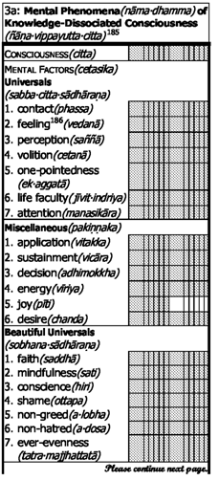
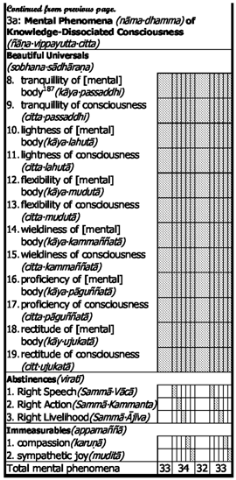
185 The tables that follow (3a & 3b) have been designed according to the combination sysrem(satigaha·naya): all combinations of mental phenomena. (AbS.ii.40-42 ‘Kam’Avacara·Sobhana·Cit/:a·Sarigaha·Nayo’ (‘Sensual-Sphere Beautiful-COnsciousness CombinationSystem’) O<1A.ii.24, and AbS.ii.33-34:sabhana·CetasiA<1·Sampayc:ya·Na”,'(‘Beautiful Mental-FactDr Association-System’) CMA.ii.17.) One column is one type of consdousness, with mental factors shaded.
186 Feeling: a wholesome consdousness is associated with either pleasure(.s”omana.s!”a), or equanimity(~): both mental feelings. When there is pleasure, there is also jay(pi/ii, when there is equanimity, there can be no joy.
For example, it is very rare for children to offer with knowledge of the workings of kamma. Usually children will offer because they want to copy their parents, or because their parents have told them to offer, or because they enjoy offering, or enjoy being praised when they offer. Even most adults offer without knowledge of the workings of kamma. One may offer, for example, out of loving-kindness, wishing to help another, such as offering food and other requisites to the poor, the starving, etc. One may also offer to ascetics and monks, etc. because of kindness. One may also offer because it is custom or tradition, or because one’s religion says one should. And one may offer because of conceit, wanting to have a good name, and be respected. One may even offer because one is afraid of blame. When parents give something to their children there is usually also much attachment and unwise attention (thinking, ‘This is my son’, or, ‘This is my daughter’): the same when a husband gives something to his wife, a wife to her husband, a friend to a friend, etc. One may even offer with wrong view: offering and believing that there is no result from offering, that there is no rebirth after death, etc.
66
The Workings of Kamma
Even so, offering is in all cases wholesome: if it is interspersed by wholesome consdousnesses, it can even be superiOr(ukkattha). But when it is dissociated from knowledge of the workings of kamma, it is the less superior, for it is only double-rooted(cM·hetuka): associated with only non-greed(a’/obha) and non-hatred(a·cb.sa). The kamma being less powerful means the result will also be less powerful.
187 Tranquillity of [mental] bodY/consciousness: see footnote 150, p.54.
III – The Workings of Kamma
KNOWLEDGE-AsSOCIATED
Offering with knowledge of the workings of kamma is more powerful. Why? Because the presence of wisdom means the consciousness is triple-rooted(li’hetvka): rooted in nongreed(a.fobha), non-hatred(a’cb!a), and non-delusion(a·moha). That always makes a wholesome kamma more powerful.
A further important factor is whether the offering is inferior(omaka) or superior(ukkattha)·
67
THE INFERIOR OFFERING
What are the factors for an offering that is inferior(omaka)? There are four:97
1) The offerer has obtained the requisite by wrong livelihood.
2) The offerer has poor or no morality: she or he keeps only some precepts, or no precepts at all.
3) Before or after the kamma consciousnesses of the actual offering, the offerer’s mind is associated with unwholesome things. For example, before offering, she or he may have been angry or impatient; she or he may be dissatisfied with the requisite, or she or he may offer in a casual or distracted manner; after offering, she or he may regret having made the offering. 190 She or he may also have only shallow faith in the workings of kamma. She or he may also make the offering with the wish for some worldly gain, or for sensual pleasures in a future life as a rich human being, or a deva.
4) The receiver has poor or no mo-
rality: she or he keeps only some precepts, or no precepts at all.98
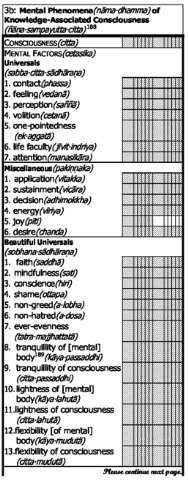
188 See footnote 185, p.65.
189 tranquillity of bodY/-consdousness : see footnote 150, p.54. 190 See, for example, ‘The Parsimonious Millionaire’, p.34.
68
The Workings of Kamma
These are examples of how one’s offering can be interspersed by countless thousand million unwholesome consdousnesses rooted in greed(Iobha), hatred (dosa), and delusion(moha). That makes one’s offering inferior. If in such a case, one does not understand
the workings of kamma, it is dissociated from non-delusion, which makes one’s offering inferior, double-rooted(cM·hetuka): that means the resultant consciousness will be unrooted(ahetvka). If one does understand the workings of kamma, it is assodated also with non-delusion(a’moha), but even so the interspersion of countless unwholesome consdousnesses make one’s offering inferior, triple-rooted(li·hetuka):
that means the resultant consciousness will be only doublerooted (dvi·hetJJka).
In the Pali Texts, there is an example of a man who makes such inferior offerings.’92 In one of His past lives, when He was only an unenlightened Bodhisatta, The Buddha was a hennit(ta.£WQ) called Kal)hadipayana. One day, a father and mother brought their young son to him, because the boy had been bitten by a snake. And to counteract the poison, they all decided to make declarations of Truth (&ao·kinya). After the Bodhisatta had made his declaration, the father made his. He declared that he made offerings without delight, unwillingly: not having faith in the results of making offerings, he made offerings without conviction. That means his offerings were all inferior.
THE SUPERIOR OFFERING
The factors for an offering that is superiOr(ukkattha) are the opposite:
1) The offerer has obtained the requisite by Right Uvelihood.
2) The offerer has good morality: she or he keeps the precepts.
3) Before or after the offering consciousnesses, the offerer’s mind is assodated with wholesome things. For example, before offering, she or he may with joy (pili/93 have made great effort to get good requisites; she or he may offer in a respectful, concentrated, and joyful manner; after offering, she or he may
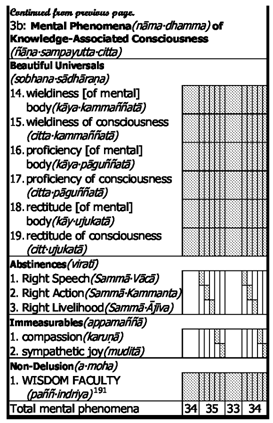
191 wisdom faculty: here, it is the Kamma-Clwnership Knowledl;Je(Ka/11/TfJ·Ssakata·N8I}aIh/Pi1iifia): see ‘The Five Types of Knowledl;Je’, p.56.
192 JA.IV.X.6 <444> ‘Ka(lhadTpiiyana·.Jaf11ka·Ii!I(I(lana'(‘Descriplion of the Kal)hadipijyana Jataka’)
193 The feeling is pleasure(.s”Omanasli1), whid1 arises with jOY(pi/:J): see footnote 186, p.64.
III – The Workings of Kamma
69
rejoice over having made the offering. And she or he has deep faith in the workings of kamma. She or he may make the offering with the wish for Nibbiina.
4) The receiver has good morality: she or he keeps the precepts. The most superior receiver is, of course, a Buddha, another Arahant,’94 a Noble One, or one practising for the attainment of Arahantship. But the even more superior receiver is one or more bhikkhus or novices seen as representatives of the Sangha.99
These are examples of how one’s offering can be interspersed by countless thousand million wholesome consciousnesses associated with non-greed (a’/obha), non-hatred(a·cb.!a), and joy(pitI). If one does not understand the workings of kamma, it is dissociated from non-delusion, which makes one’s offering superior, double-rooted(cM’hetvka): that means the resultant consciousness will be doublerooted. If one does understand the workings of kamma, it is associated also with non-delusion(a·moha), which makes one’s offering superior, triple-rooted(li’hetvka): that means the resultant consciousness will be triple-rooted.
MORALlTY
The second merit-work base is morality(S/7a): to abstain from certain unwholesome kammas. It comprises the three abstinences(vi/OI1): Right Speech(&mma.V8Gj), Right Action(Samma·Kammanl1J), and Right Uvelihood(&mma·AiTva), which is, livelihood that excludes wrong speech (micdla·vaai) or wrong action(micdla’kammanI1J).’95 These abstinences arise on three occasions: 196
1) There arises an occasion to do an unwholesome thing(akusala dhamma). But one abstains because one considers it an unsuitable thing to do. 197 This is called occasional-abstinence(.sanpatta·vi/Oli): one abstains as and when the occasion arises.
2) There arises an occasion to do an unwholesome thing. But one abstains because one has undertaken the training precepts(sikkM-paiB): the five, eight, ten precepts, or the Patimokkha rule. 198 This is called undertaken-abstinence (.sarnadana·vi/Oli).
3) There arises an occasion to do an unwholesome thing. But because one has with a Noble Path Knowledge uprooted certain or all defilements, it is impossible for one deliberately to do certain unwholesome things: the Arahant
194 For some examples from the Pali Texts, see ‘Present Result from Wholesome Kamma’, p.155.
195 See the three abstinences in table ‘3a: Mental Phenomena of Knowledge-Dissociated Consciousness’, p.65f, and table ‘3b: Knowledge-Associated Consdousness’, p.67.
196 DhSA.i.1 ‘Kusa1a·Kamma·Patha·Katha'(‘Discussion of the Wholesome Kamma-COurse’) E.136-137
197 DhSA.ibid gives the example of a young boy who is asked to catch a hare, for his mother to eat as medicine. He chases a hare, and it gets caught in some creepers, eying out in fear. He thinks: ‘It is not proper that for the sake of my mother’s life, I should take the life of another,’ and frees the hare. Coming home, he declares before his mother that he has never intentionally killed any being. With that declaration, his mother recovers from her sickness.
198 DhSA.ibid gives the example of a man who is caught by a boa-constrictDr. Thinking first to kill it with his axe, he remembers that he has taken the precepts from a bhikkhu, and throws the axe away. And the boa-mnstrictDr releases him.
70
The Workings of Kamma
Path-Knowledge makes it impossible for one deliberately to do anything unwholesome at all. ’99 In this case, one’s abstinence is natural, and is called uprooting-abstinence(samuccheda·virali).
The occasional, arbitrary morality is the inferior morality, whereas morality as a training is superior.
Let us then discuss the different types of morality training.
THE F’VE PRECEPTS
Basic morality training is to abstain from the five main unwholesome kammas: 100
1) From killing to abstain/P8!l8lipata veramalJl7: she or he does not kill any being: human, animal, fish, insect, etc.
2) From taking what is not given to abstain(a-dinn·8t:B!78″ veramalJl7: she or he obtains things in a lawful way.
3) From sexual misconduct to abstain(kamesv mia:ha-cara verafTliJ(li). she or he is content with her or his husband or wife.2OO
4) From untrue speech to abstain (mu.s;ii·va.:m verafTliJ(li). she or he does not tell a lie for any reason. She or he either speaks the truth, or is silent.101
5) From beer&wine liquor, which is a foundation for carelessness, to abstain (sutii·meraya·majja·pamada·tfh8na veratnalJl7 :20′ she or he does not take any type of intoxicant, for any reason. Indulging in intoxicants makes it very difficult to train in morality, leads to harm, 102 and eventually to dementia.202
These five abstinencesO>aiko verafTliJ(li} are what we call training precepts(sikkha-pada): the five precepts(paii(o·S/7a). A devotee(upasikajupasaka) of The Buddha, Dhamma, Sangha observes minimum these five precepts: that is the devotee’s quality of morality achievement(S/7a·sampatB).203
But included in one’s moral training is, of course, also Right Uvelihood(&mma·AiTva): to abstain from wrong Iivelihood(m’at>a a;Tva). That is, not to gain one’s livelihood by breaking any of one’s precepts.204 To abstain from killing, theft, sexual misconduct and intoxicants is Right Adion(&mma’Kammanta); to abstain from lying, slander, harsh speech, and prattle, is Right Speech(&mma·V8Gj); and to abstain from all of them in one’s livelihood is part of Right Uvelihood. For devotees (upasikajupasaka), The Buddha includes also abstinence from five types of trade: 103
’99 DhSA.ibid explains that when one attains the Noble Path Knowledge, the Noble Eightfold Path arises, with Right Speed1, Right Action, and Right Livelihood. Once it has arisen, one can no longer intentionally break any of the five precepts. See ‘The Ten Wholesome Courses of Kamma’, p.128.
200 For those who are ‘unapproachable ones(aga/TliJfliya’WJtfJ1u}’, see quotation at ‘To Be One Who Engages in Sexual Misconduct’, p.119.
20′ For an analysis, see ‘Beer&Wine Liquor’, p.367.
202 See ‘The Trivial Results of Unwholesome Kamma’, p.125.
203 The details with regard to the female/male devotee have been taken from DA.i.2 ‘Samal’iffa-PhaIa-Suttafh'(‘The Asceticism-Fruit 5utta’).
204 DhSA.i.301 1Clkutt<1″‘-kltsa/a-Iie!1(7ana'(‘Desaiption of the 5upramundane Wholesome’) E.298 explains: ‘For the sake of livelihood, whatever breathers hunters, fishermen, etc., may kill, whatever theft people may commit, however they may wrongly behave themselves: this is known as wrong livelihood … After taking a bribe, whatever lies they may speak, whatever slander they may utter, harsh speech, or prattle: this is known as wrong livelihood; abstinence therefrom is Right Livelihood.’
III – The Workings of Kamma
71
1) Anns trade(sattha,v8IJiii3}
2) Beings trade(satta·va!7fffii}: selling human beings.
3) Resh trade(mamsa·va!7fffii}: rearing pigs and other animals, and selling them
for slaughter.
4) Uquor trade(majja·va!7fffii}: any type of intoxicant.
S) Poisons trade(vilil·va!7fffii}: herbicide, insectidde, and any other type of poison. To be a devotee(~ka/~ka}, one’s livelihood needs to exclude all these five
trades, for one’s livelihood needs to be in accordance with the Dhamma(Dhammena samena). that is the devotee’s quality of livelihood achievement(~7va·sam~}. If one engages in any of these types of wrong livelihood, or if one breaks any of the five precepts, of course, one’s Triple Refuge(77·,S3IO!lB} is broken, and one is no longer a devotee(~ka/upasaka} of The Buddha, Dhamma, Sangha:205 one is then what The Buddha calls an outcast devotee(upasaka’ca(lffala}, a dirty devotee(~ka‘mala}, and a vile devotee(~ka·pafjku(!ho}.l04
The five precepts help prevent the most dangerous acts of greed, hatred, and delusion. When one kills, steals, engages in sexual misconduct, lies, and drinks beer and wine, etc., the volition is unwholesome: it is unwholesome kamma. If that kamma produces its result at the time of death, one will be reborn in hell, the ghost world or the animal world. 105 This causative fixity, the natural order of kamma,>06 is why The Buddha, the bhikkhu-, and bhikkhuni Sangha, and devotees teach the five precepts:207 not to undertake them is to one’s own detriment and harm for a long time. Hence, the five precepts are not unique to a Buddha’s Teachings.208/106 Outside the Dispensation of a Buddha, they are taught by ascetics and wanderers,209 Bodhisattas bound for Full Enlightenment, and Wheel- Turning Kings. 107
The Buddha mentions also s1ander(pisu!lB’vaa;}, harsh speechO>haIVsa·vaa;}, and prattle(samphawatapa}, as kamma that can give such a rebirth, but they become more difficult to do when one observes the five precepts in one’s daily life. 108
If one in this way observes the five precepts in one’s daily life, and one makes a living by Right Uvelihood, one may avoid an unhappy rebirth, and gain a happy rebirth in the human world or even the deva world.210
205 KhPA.i2Y7ed.Ab’1eda’R’1ak1.~na'(‘IIIuminalion of the Fruit of Bread1/Non-Bread1’) MR.i.23 explains, for example, that the blameless(ana~} bread1 of one’s refuge takes place at death. The blameful(.f8I.9.ffa} bread1 takes place when one takes another teacher as refuge, or one takes refuge in an improper way (details are given for the proper ways). The refuge becomes defiled(sam.tU@1a}by non-knowledge(a~}, doubt (sadIsaya), and wrong knowledge(m’aM·ffaQa} about a Buddha’s qualilies(9U!lB} (for example, holding wrong views about what a Buddha is or is not, what He does or does not do, or what He can or cannot do), and is defiled also by disresped:(anMam},etc. tDwards The Buddha,the Dhamma (Vinaya, Sutta, Abhidhamma), or the Sangha.
206 To explain this, VbhAXVI.10.iii.770 77A<1·N.t:fdes;a·Iie!1(7ana'(‘Desaiplion of the ThreesExposition’) DDXVI.iii.2082 quotes S.II.I.ii.10 ~)e·Suttam'(‘The Cause Sutta’): ‘Whether there is the appearance of Tathagatas, or the non-appearance of Tathagatas, there exists this element, the Dhamma fix’ro((Oha/mIiJ-tf/1i/:at3}, the Dhamma order(Dha/mIiJ”‘iy8m;Jt3}, causation(kf.wacr8J6ta}.’
207 VbhA.XVI.x.3.770 77A<1·N.t:fdes;a·Iie!1(7ana'(‘Desaiption of the Threes-Exposition’) DD.XVI.x.2082
208 Ibid.
209 For example, the Brahmins called Sarikhas: see ‘The Fantastic Picture’, p.31. 210 See endnote 124, p.239.
72
The Workings of Kamma
THE EIGHT PRECEPTS
There are also devotees who observe the eight precepts(attfJa·S17a). The eight precepts are: 109
1) From killing to abstain/P8!l8tipata veramalJl7: this is the same as the first of the five precepts.
2) From taking what is not given to abstain(a-dinn·8t:B!78″ veramalJl7: this is the same as the second of the five precepts.
3) From unchastity to abstain(ab/Ohma-can’ya veramalJl7: this precept is purer than the third precept of the five precepts. There she or he does not engage in sexual misconduct; here she or he does not engage in any type of sexual conduct. It greatly denourishes sensual desire(kama-cchanda).110
4) From untrue speech to abstain (mu.s;ii·va.:m verafTliJ(li). this is the same as the fourth of the five precepts.
5) From beer&wine liquor, which is a foundation for carelessness, to abstain (sutii·meraya·majja·pamada·tfMna veratna1Jl7: this is the same as the fifth of the five precepts.
6) From eating at the wrong time to abstain (vi·kala·bhojana veramalJl): she or he does not eat between noon and the next day’s dawn. It greatly denourishes sensual desire(.l”ama-cchanda) and s1oth&torpor(thina·mktfha), and helps nourish contentment(.saI7ta!qf.santuttf7i), and moderation in food(bhojane·matl1Jffiiuta).
7) From dandng, singing, music, and watching other entertainment(naao’gila·vadjf;J·visiJka-dassana-j, from jewellery, perfume, and cosmetics, for the sake of adornment to abstain(-tna/a·gandha·vilepana·rJharalJ8·mafl¢ana·vibhO.san·atfMna verama1Jl7: she or he does not indulge actively or passively in music and other entertainment. That greatly denourishes greed, hatred and delusion. And she or he does not beautify the body by appearance or smell. That greatly denourishes sensual desire and vanity(mada).
8) From a high and large bed to abstain(ucca·.sayana·maha·.sayana veramalJl7: she or he does not indulge in a big and luxurious bed, and sleeps alone. It denourishes sensual desire and s1oth&torpor.
The eight precepts are also not unique to a Buddha’s Teaching.2II They are practised by good people also outside a Buddha’s Dispensation.111 Some people train in the eight precepts as a way of life, and some train in them only occasionally, especially on the Uposathas: the new moon and full-moon days. 112 The Buddha calls such practice the Uposatha possessed of eight factors(af!h·anga·samannaga(;J Uposatha). 113 And He explains that with such practice, one emulates the Arahants.114 The results of such a practice are, He explains, the complete happiness of rebirth in the deva worlds, with a life span from nine million human years, up to nine thousand, two hundred and sixteen million human years. And He explains that such practice may also be a supporting cause for the Path&Fruition of Non-Return, Once-Return, or Stream Entry.115
THE TEN PRECEPTS
Apart from the five and eight precepts, there are also the ten precepts(cB!a·S17a).
With the ten precepts, abstinence from entertainment becomes the seventh precept, abstinence from beautifying the body becomes the eighth precept, and ab-
2II VbhAXVI.x.3.770 77A<1·Mddes;a·Iie!1(7ana'(‘Desaiption of the Threes-Exposition’) DDXVI.x.2082
III – The Workings of Kamma
73
stinence from a high and large bed becomes the ninth. And then there is the tenth precept:
10) From accepting gold and silver to ab&ilin(j3l1JrOpa’rajal1J’papggahana verBfTIiJ(Ii). this does not refer only to gold and silver, but to any type of money: cash, cheques, drafts, credit cards, etc.116
Possession and use of money is inseparable from greed, hatred, and delusion.117 That is why not to have money denourishes greed, hatred and delusion.
There are some laypeople who undertake the ten precepts, and a Theravada novice(.s;iima~) is ordained by the ten precepts. Theravada nuns are ordained by either the eight precepts, or the ten. Here again, the ten precepts are not unique to a Buddha’s Dispensation.212
THE BHIKKHU’S MORAUTY
The highest training in morality is the bhikkhu’s morality(bhikkhu·sila). It is the first of the bhikkhu’s three trainings:213 The Buddha calls it the higher morality training(adhi·S17a·sikkM). A bhikkhu’s morality is the foundation of his holy life, and is a fourfold purification morality(cal1J·parisudtfhi·S17a):214
1) The Patimokkha-restraint morality(Palimokkha·samvara·sia):215 this is the bhikkhu rule laid down by The Buddha. It comprises a chief two hundred and twenty-seven precepts, as well as very many associated precepts.
2) Faculty-restraint morality(i7tmya-.samvara·S17a): restraining the eye-, ear-, nose-, tongue-, body-, and mind faculty by attending to one’s meditation subject, be it samatha or vipassana. That way defilements do not arise by way of the six faculties. 118
3) Uvelihood-purification morality(iijNa·parisuddhi·sia): just as a layperson must abstain from wrong livelihood, so must a bhikkhu.119 Wrong livelihood for a bhikkhu is a livelihood that breaks any of the Patimokkha precepts. 120
4) Requisite-related moralityO>aaoya-.sannissila·S(7a). The bhikkhu receives his four requisites from the faithful:
i) the robe(civara)
ii) the almsfood(pi¢apal1J)
iii) the bed&seat(~·ii.sana): that is the Pali word for his dwelling.
iv) the medical requisite to help the sick{giliina·paa:aya·bhesajja-parikkMra).
As part of his moral training, the bhikkhu must reflect upon his four requisites with wise attention(yonisl:> manasikara). For example, The Buddha advises the bhikkhu to reflect upon his food in the following way:216
Witfl wise reflection tfIe almsfood do I use: ‘[It is] neither for fUn, nor for inlDxication, nor for beautification, nor for embellishment; only for this body’s subsistence and mainblnance, for hann’s prevention, for assisting the holy life. 217
212 Ibid.
213 The bhikkhu’s three higher trainings: see quotation endnote 40, p.25. 214 VsM.i.13ffS71a-Nb’desl:1′(‘Exposition of Morality’) PP.i.42ff
215 Patimokkha restraint: see quotations endnotes 40, p.25, 121, p.239, and 284, p.351. 216 The Buddha explains it in, for example, M.I.i.2 Sabb-A5aIe-Suttam'(‘The All-Taints 5utta’) and A.VI.vi.4~-Suttam'(‘The Taints 5utta’). And in 5.IV.xii.7’Rath-Opama-Suttam'(‘The Chariot-5imile 5utta’), He equates this with moderation in food{bhcTjanematfJJfifiuIa). 217 FUN: as Village boys eating for the pleasure of eating, or as a social event. INlOXICATlON:
{fIt- •••• {wt1/u1< IIeOCtpage.)
74
The Workings of Kamma
Thus, old feelings [of hunger] I put an encIlD; and new feelings [of overeating] I do not arouse; and my livelihood will be blameless, and a living in comfort.’
When the bhikkhu in this way reflects on his requisites,218 he is able to develop contentment(.sanlnla/.sanllltti). When a bhikkhu develops contentment, he does not ask much from his patrons(cmyaka) and stewards(kaWfya). That means his holy Iife(bJahma'(Qn’ya) becomes blameless.
The bhikkhu’s four trainings in purification greatly help to control his mind, to prevent much kamma that is greed-, hatred-, and delusion-rooted. In that way the bhikkhu’s higher morality training greatly helps him in his development of jhana (samatha), which The Buddha calls his higher-mind training(adhi·dtta·sikkM).121 It helps the bhikkhu in also his insight training, which The Buddha calls his higher wisdom training(adhi·palina·sikkM).219 Furthennore, when a bhikkhu observes his morality training scrupulously,l22 the True Dhamma may continue for a long time.123
All these different types of morality are opposite greed and hatred; rooted in non-greed(a’lobha), and non-hatred(a·cb.!a). And if we practise morality without faith in the Kamma-Ownership Knowledge(Kamma·S.sakata·Na!l8), it is knowledgedissociated(iiala·vippayutta): double-rooted(cMhEtvka). If we practise in morality with faith or direct knowledge of the Kamma-Ownership Knowledge, it is knowledgeassociated (na!l8·.sampayutta): triple-rooted(ti-hetuka).
THE WORKINGS OF MORALITY TRAINING KNOWLEDGE-DISSOOA TED
For example, it is very rare for children to train in morality with knowledge of the workings of kamma. Usually children will train in morality because they want to copy their parents, or because their parents have told them to train in morality, or because they enjoy being praised when they train in morality.
One may also train in the precept of not killing, for example, not because of one’s training, but out of loving-kindness, not wishing to hann another. And one may be selective. One may abstain from killing human beings of one race, of one religion, or of one country, yet kill human beings of another race, or religion, or country. One may abstain from killing human beings who have done no wrong to oneself, one’s family, one’s friends or associates, etc., yet one will kill human be-
infatuation with health and strength, as in athletes. BEAUIlFICATlON: to look attractive, as in concubines and prostitutes etc. EMBELL1SHMENr. to look graceful, as in actDrs, dancers etc. (VsM.i.18ffS7la·Nb’desl:1′(‘Exposition of Morality’) PP.i.89-94)
218 For The Buddha’s advised reflection on the robe, see quotation endnote 24, p.22.
219 VbhAXVI.x.3.770 77A<1·Mcfdes;a·Iie!1(7ana'(‘Desaiption of the Threes-Exposition’) DD.XVI.x.2082 explains: ‘But the morality of Patimokkha restraint exceeds all morality, and arises only when a Tathagata has arisen, not when one has not arisen; and only the Omniscient Buddhas make it known. For making it known thus: “In respect of this basis, this is the offence” is the field of the Buddhas only, the power of the Buddhas.’ Ibid.2085 explains the bhikkhu’s threefold higher training: ‘Just as, compared to an undersized umbrella or flag, and over-sized one is called a super-umbrella, a super-flag, so, compared to the fivefold morality and the tenfold morality, this Patimokkha morality is called higher morality, and compared to the round-basis eight attainments [jhana for the attainment of a higher rebirth], the vipassana-basis eight attainments [jhana for the practice of vipassana] are called the higher mind, and compared to the kamma-{)Wnership wisdom, insight wisdom and Path wisdom and Fruition wisdom are called the higher wisdom.’
III – The Workings of Kamma
7S
ings who have done wrong to oneself, one’s family, etc.220 One may also abstain from killing human beings, yet kill other beings such as fish, rats, mice, and insects. And one may wish to protect the life of an animal one considers to be beautiful or interesting: for example, a hawk or eagle, a dolphin or whale, or a lion or tiger, or an elephant or gorilla, or even a butterfly. Yet one may not wish in the same way to protect the life of an animal one considers to be ugly: for example, a vulture or crow, a shark, a jackal or fox, or a rat, a cockroach, a wasp or a mosquito. In the same way, one may out of compassion abstain from eating pork, beef, and poultry, yet not abstain from eating eggs, fish, and other seafood. And one may abstain from eating flesh for reasons of health, rather than out of compassion.
One may also train in morality because of a sense of honour, and abstain from killing, stealing, sexual misconduct, and telling lies, yet one will drink beer and wine, etc. And one may also train in morality because it is custom or tradition, or because one’s religion says one should. One may also train in morality because one wants to have a good name, and be respected. And one may even train in morality because one is afraid of blame. In these many ways, one’s training in morality may be knowledge-dissodated(~.vip.£Wyutta). 221
Even though the consdousnesses by which one abstains from evil actions may be dissodated from knowledge of the workings of kamma, they are not for that reason associated with ignorance and wrong view. As we explained, a wholesome consciousness cannot be associated with ignorance. But one may at other times hold to wrong view. One may believe that there is no result from doing bad and doing good, one may believe that at death, one is annihilated, and one may believe that the deva worlds and the hells are just legends or metaphors for unwholesome consciousnesses. And one may think the five-, eight-, and ten precepts, and the bhikkhus’ many precepts, are just cultural things from ancient India. When there is in this way no faith in or knowledge of the workings of kamma, etc., there is, of course, no fear of a bad rebirth, and no fear of the round of rebirth. Then can it be very difficult to train properly in morality.
When one in these ways trains in morality without faith in or knowledge about the workings of kamma, it is much more difficult to do. If there is some inconvenience, one very easily gives up. For example, one may discover vermin in one’s house, and choose the easy solution: to kill them or have them killed. One may also want to entertain business associates, or enjoy the company of one’s friends, and then drink beer and wine, etc., because it is expected. When dedaring one’s taxable income, and when doing business, for example, it is very easy to tell lies,
220 VsM.i.12 ‘Sila-Ppabheda-KatM'(‘DiSOJssion of the Morality-variety’) PP.i.31 explains that there is morality whim is restrictedO>ariJenta} by gain, fame, relatives, limbs, and life, and there is morality that is unrestricted(iJ18$1nta). It quotes PsM.I.ii.37 ‘Silamaya-fia(la-Nido’esl:1′(‘Exposilion of Morality-comprising Knowledge’) PD.I.ii.258: ‘Here, someone with gain as root, with gain as cause, with gain as reason, transgresses an undertaken training precept: such morality is restricted by gain (see, for example, footnote 222, p.76).’ The other restrictions should be understDod in the same way. PsM.ibid. explains that sum morality is in pieces, is not praised by the wise, is inseaJre, does not lead to concentration, is not a basis for non-remorse, happiness, knowledge & conduct:, etc., and does not lead to Nibbana. Unrestricted morality is the opposite.
221 For the mental phenomena of sum consciousness, see table ‘3a: Mental Phenomena of Knowledge-Dissociated Consciousness’, p.65f.
76
The Workings of Kamma
with the excuse that one must make a living, and the excuse that everyone does it.222
Nonetheless, in all cases, abstention from evil actions is wholesome: if it is interspersed by wholesome consdousnesses, it can even be superiOr(ukkaffha). But when it is dissociated from knowledge of the workings of kamma, it is the less superior, for it is only double-rooted(cM’hEtvka): associated with only non-greed (a.fobha) and non-hatred(a-a’asa). The kamma being less powerful means the result will also be less powerful.
KNOWLEOGE-ASSOCIATED
When one’s training in morality is knowledge-associated(M!l8·.sam.tayulta), it is much, much easier to do. With that knowledge, one becomes afraid to do wrong, because one does not want to suffer the results of unwholesome kamma. With knowledge of the workings of kamma, one knows that immoral conduct leads not only to a bad rebirth, but in this life, it leads to restlessness, unhappiness, and low self-confidence. 124 With knowledge of the workings of kamma, one knows that the higher the training one undertakes, the more happiness and self-confidence one gains. One knows it is inevitable. One has experience of the good things that accompany the wholesome consciousness: conscience{1>in’), shame (otI1Jppa), tranquillity of consciousness(dtta·~hi), mindfulness(.sati), and faith (saddha). in short, happiness(sukha). Such happiness is very important if one wants to succeed in the third merit-work base, meditation (bhavana).125These inevitable benefits from morality, in this life and in the future, are why The Buddha explains that we should reflect on the Kamma-Ownership Knowledge every day:2231126
Kamma owner am I(kamma·ssakDmhi), kamma heir(kamma’cmyBtb), kamma-born (kamma·yoni), kamma-bouncd(kamma·mndhu), kamma-protected(.tamma·.ta!i.saIO!1O): whatever kamma I do, good or bad, of that I shall be heir.224
Morality with such knowledge of the workings of kamma is more powerful.225 Why? Because the presence of wisdom means the consdousness is triplerooted(ti-hetJJka): rooted in non-greed(a’/obha), non-hatred(a’cb!a), and non-delusion(a·moha).226 That always makes a wholesome kamma more powerfulY7
Most powerful, of course, is the knowledge-associated morality of the one who has attained a Noble Path Knowledge(An’ya-~’Na!l8) and Fruition Knowledge (Pha1a·Na!l8): a Noble Disciple. The arising of the Path Knowledge is the arising of the Noble Eightfold Path(An’ya At!h.Atigika ~): 128
1)Right View ………….. (Samm3·Diffhi) 5) Right Livelihood .. (Samm3·~7va)
2)Right Intention (Samm3·Satikappa) 6) Right Effort …….. (Samm3·lIliyama)
3)Right Speech ………… (Samm3·I/liGj) 7) Right Mindfulness . (Samm3·Sati)
4) Right Action …. (Samm3’Kammanta) 8) Right Concentration (Samm3·Samadhi)
With the arising of these eight Noble factors, the three morality factors (Right Speech, Right Action, and Right Uvelihood) will have eradicated wrong speech, wrong action and wrong livelihood. One is no longer able deliberately to kill be-
222 This is morality restricted by gain. See footnote 220, p.75.
223 A. V.II.i.7 ‘Abhi(lha·Paccavekkhif11bba(hana·Suf:f11n’1’ (‘The Often-to-Be-Refled:ed Sutta’) 224 See also quotation p.256.
225 This is unrestricted morality: see footnote 220, p.75.
226 For the mental phenomena of sudl consciousness, see table ‘3b: Mental Phenomena of Knowledge-Associated Consciousness’, p.67.
III – The Workings of Kamma
77
ings, to steal, to engage in sexual misconduct, to tell lies, to drink beer and wine, etc. And above all, Right View will have eradicated wrong view. 129 To attain this Path Knowledge, one will namely have attained also the Cause-Apprehending Knowiedge(Paa”aya’Pa~ha’~)’ And with that knowledge, one will have discerned past and future lives, and will have known and seen the workings of kamma: how certain kamma matures after death, to produce the rebirth-linking consciousness and new aggregates. Having in this way known and seen the workings of kamma, one is unable to hold any wrong view. 130 And with the arising of Stream-Entry Path Knowledge, one’s morality is not only triple-rooted, but one is certain never again to be reborn in hell, as a ghost, or as an animal. With the arising of the Non-Return Path Knowledge, one is certain never again to be reborn in the sensual world. And with the arising of the Arahant Path-Knowledge, one is certain never ever again to be reborn in any way. 227
Before that takes place, however, a further important factor in one’s morality is whether it is inferior(omaka) or superior(ukkattha).
INFERIOR MORAL1TY
What makes one’s morality inferior(omaka)? If, before or after the abstaining consciousness, one’s mind is assodated with unwholesome things, it is inferior. As we just explained, when one’s morality is dissociated from knowledge of the workings of kamma, abstinences may often be selective or arbitrary. SUch abstinence is usually inferior. Why? Because immediately before and after abstaining, there will usually be greed-rooted consciousnesses. Farther away, there may be non-abstinence, either greed-rooted or hatred-rooted consciousnesses. For example, one may abstain from killing a butterfly, because one thinks it is beautiful: thinking it is beautiful is greed-rooted consciousness. And one may, on the other hand, make effort to kill mosquitoes and cockroaches: that is hatred-rooted consciousness. That way, one’s abstinence is interspersed by greed, hatred and delusion. One may abstain from stealing from a member of one’s own family, an inhabitant of one’s own village, or someone from one’s own country: that is conceit, greed-rooted consdousness. But one may happily steal from a member of another family, an inhabitant of another village, or someone from another country: that is greed, hatred, and delusion. This same principle goes for all the examples we gave for selective or arbitrary morality. Usually, it will be dissociated from knowledge of the workings of kamma. But it can also be associated with such knowledge. One may, for example, think: ‘Later, later! I have to look after my family and my property. When I get older, I can train in morality properly.’ Or: When I go on a retreat, or stay in a monastery, I can train properly in morality.’ Such arbitrary morality is interspersed by greed- and hatred-rooted consciousnesses, which makes it inferior.
Then there is the inferior undertaking of the precepts. One may, for example, undertake them unwillingly. Because of a view, one may think undertaking the precepts is old-fashioned and therefore wrong; because of conceit, one may dislike the formal ritual of taking the precepts from a bhikkhu; or because of a view one may dislike having to learn the Pali formula. But one may be prompted by friends or family to undertake the precepts, and one may be ashamed to let them know one does not want to keep all the precepts. So, unwillingly one goes to the bhikkhu, unwillingly one learns the Pali, and unwillingly one undertakes the pre-
227 For further details, see ‘Path&Fruilion’, p.330.
78
The Workings of Kamma
cepts. Then one’s undertaking is interspersed by unwholesome consciousnesses associated with views (greed-rooted), and boredom and dissatisfaction (hatredrooted). Later, remembering or reminding oneself that one has undertaken the precepts, one may with dissatisfaction continue observing them.
Also, one will in the course of the day meet opportunities to break one’s precepts. For example, a mosquito comes, and sits on one’s arm. When one consciously refrains from killing it, wholesome consciousnesses arise, but one may do it unwillingly, actually wishing to kill the mosquito. Another good example is the devotee who unwillingly undertakes the eightfold Uposatha training for a day: all day she or he is bored and unhappy, wishing the day was over. She or he trains in morality unwillingly, or impatiently, and without joy.
Here again,228 there is the example of the Bodhisatta, when he was the hermit called Kal)hadipayana: we mentioned before how he made a dedaration of truth to save the life of a boy who had been bitten by a snake. His dedaration of truth was that only for the first week as a hermit did he live the holy life happily, with the desire for merit(puffii·atthikD). After that, he lived the holy life, and practised jhana, unwillingly, without conviction. That means he practised both good morality as well as concentration with dissatisfaction: then both those bases for work of merit became inferior, over fifty years.
Inferior is also good morality that one maintains out of a desire to become famous, for some worldly gain, or for a happy existence in the future. And inferior it is too if one becomes proud of one’s good morality, and looks down on those whose morality is not as good.
These are examples of how one’s morality, the kamma of abstinence, can be interspersed by countless thousand million unwholesome consciousnesses rooted in greed(1obha), hatred (cfa!a), and delusion(moha). That makes one’s morality inferior. If one does not understand the workings of kamma, it is dissociated from non-delusion, which makes one’s morality inferior, double-rooted(dvi·hetuka): that means the resultant consciousness will be unrooted(ahetuka). If one does understand the workings of kamma, it is associated also with non-delusion (a’moha), but even so the interspersion of countless unwholesome consciousnesses make one’s morality inferior, triple-rooted(li’hetvka): that means the resultant consciousness will be only double-rooted(dvi·hetuka).
SUPERIOR MORALITY
What then, makes one’s morality superiOr(ukkatthaJ? If, before or after the abstaining consciousnesses, one’s mind is associated with wholesome things, it is superior.229
For example, one may abstain from killing a mosquito or cockroach with the same joy as one abstains from killing a butterfly. Why? Because the first precept covers all beings: not just the ones we think are beautiful. Ukewise, one abstains from stealing from a member of another family, an inhabitant of another village, or someone from another country, with the same joy as one abstains from stealing from a member of one’s own family, an inhabitant of one’s own village, or someone from one’s own country. This way one’s morality is superior, because it
228 See under ‘The Workings of Offering: Knowledge-Dissociated’, p.65.
229 See also explanation from MA of how preceding/succeeding abstinence from killing makes one’s wholesome kamma superior: footnote 677, p.260.
III – The Workings of Kamma
79
is neither selective nor arbitrary. That is usually because it is associated with knowledge of the workings of kamma.
Then there is the superior undertaking of the precepts. One may joyfully go to a bhikkhu and respectfully ask to go through the fonnal ritual of taking the precepts. And with joy one may kneel respectfully before the bhikkhu, hold one’s hands in afijali, and joyfully and respectfully declare one’s taking refuge in The Buddha, Dhamma, and Sangha. Afterwards, one may joyfully, respectfully and with resolution declare one’s undertaking of each of the precepts. For example, the first precept:
Panatipata veramani sikkha·padari1 samadiyami.
The abstinence-from-killing training precept I undertake.
After one has in this way undertaken the precepts, one may have a mind of joy. Later, remembering or reminding oneself that one has undertaken the precepts, one may with joy and resoluteness reinforce one’s undertaking. In the course of the day, one will meet opportunities to break one’s precepts. For example, a mosquito comes and sits on one’s arm. And with joy one consdously refrains from killing it, but kindly waves it away. There may also arise the desire to tell a lie, but with joy one does not let it manifest in speech. Remembering or reminding oneself of one’s abstinences, again there may arise joy. And maintaining good morality is most superior if one does it out of a desire for Arahantship, with the thought: ‘This has to be done.’
These are examples of how one’s morality can be interspersed by countless thousand million wholesome consciousnesses associated with non-greed(a’/obha), non-hatred(a·cb.!a), and joy(pitI). If one does not understand the workings of kamma, it is knowledge-dissociated, which makes one’s morality superior, doublerooted(dvi-hetuka). that means the resultant consciousness will be double-rooted. If one does understand the workings of kamma, it is associated also with nondelusion(a·moha), which makes one’s morality superior, triple-rooted(li·hetvka). that means the resultant consciousness will be triple-rooted.23o
We need to remember also that so long as one has not attained a Path&Fruition (Magga·Phala), so long is one’s Kamma-Ownership Right View uncertain. Because of greed, hatred or delusion, one may stop holding Right View; one may even hold wrong view.23‘Only the Stream-Entry Path Knowledge(.sot·A.£Wtti·~·fialJ8) makes one’s Right View certain, because one will have known and seen the workings of kamma directly. That is why the Stream Enterer is unable to break any of the five precepts. Thus the most superior morality is assodated with at least the Stream-Entry Path Knowledge.232
That concludes our explanation of the second merit-work base, morality(S/7a).
230 For details, see ‘If: Inferior & Superior Wholesome Kamma, Their Roots & Resultant Rebirth-Linking’, p.60.
23′ wrong view: the absence of Right VieW does not necessarily mean the presence of wrong view, as wrong view arises only with greed-rooted consciousnesses. See tables 2AJ/2b/2c, p.46ff.
232 See ‘Stream Entry’, p.332.
评论
III – THE WORKINGS OF KAMMA – THE MERIT WORK-BASES — 没有评论
HTML tags allowed in your comment: <a href="" title=""> <abbr title=""> <acronym title=""> <b> <blockquote cite=""> <cite> <code> <del datetime=""> <em> <i> <q cite=""> <s> <strike> <strong>