
Like Tusita Page and Dhamma Earth Page for the latest news and updates!
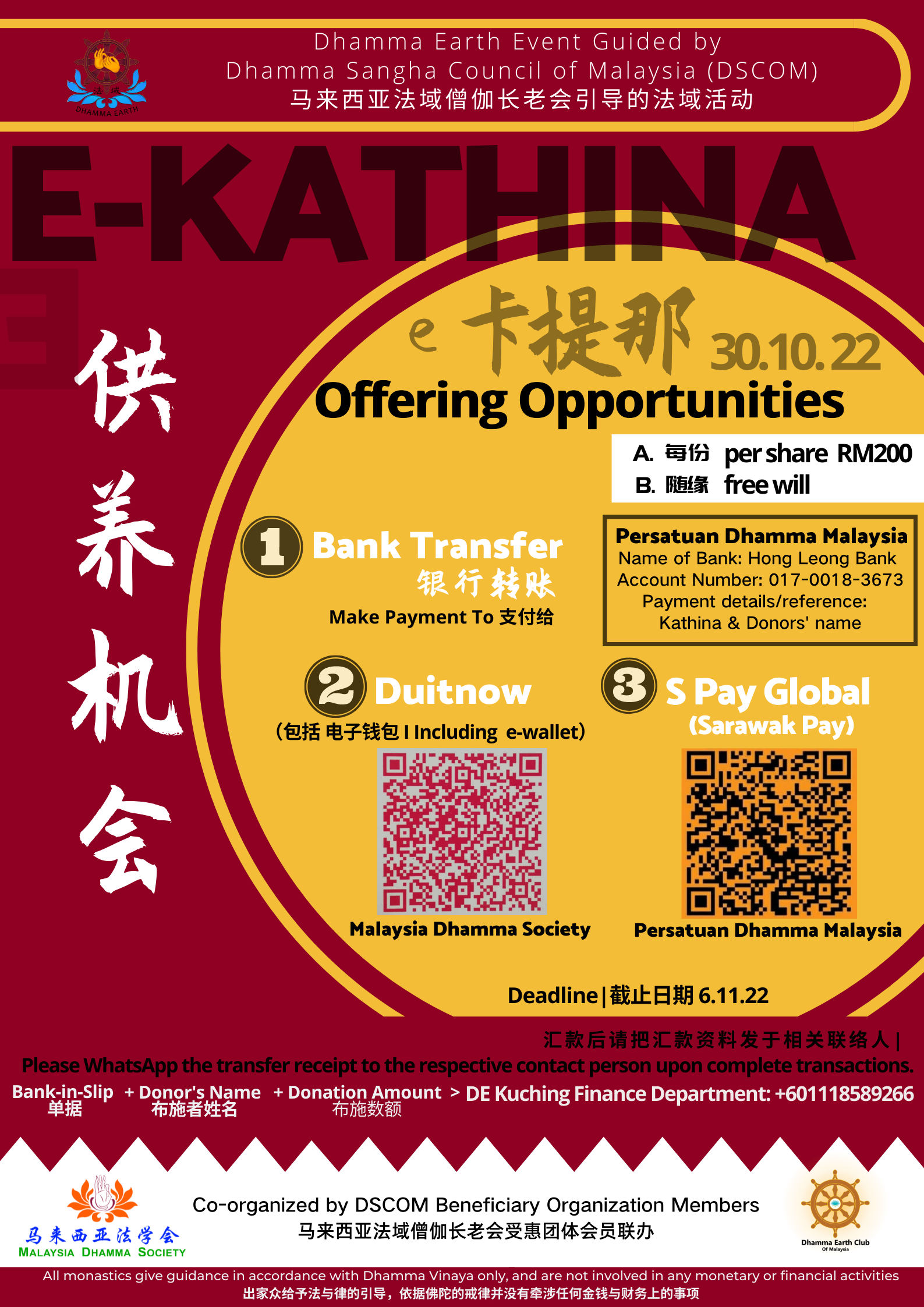
💝 2022 e-Kathina Offering Opportunity 🌸
🌱 We would like to present you with an opportunity to cultivate wholesomeness by making an offering through Kaṭhina Allowable Requisites to support monastics in Dhamma Earth Kuching (f.k.a Tusita Hermitage Kuching), Dhamma Earth Kuala Lumpur (f.k.a Semenyih Dhamma Earth) and Dhamma Earth Himalaya (f.k.a Tusita Nepal).
Kaṭhina Allowable Requisites, in the form of RM200 per share or by freewill, will allow every participant to take part in the offering of Kaṭhina Robe and offering four allowable requisites (robe, food, shelter and medicine) to the monks and nuns in the three monasteries. On the day of Kaṭhina celebration, devotees in each monastery will represent everyone to complete our good deeds of offering.
🎉 Let’s join this e-Kaṭhina to celebrate and rejoice in the merits of the monastics in the threes monasteries.
👨👩👧👦 For those who would like to make an offering, please choose from one of the following options:
1️⃣ Bank Transfer
Bank: Hong Leong Bank
Account Name: Persatuan Dhamma Malaysia
Account No :017-0018-3673
2️⃣ Online payment l DuitNow (Please scan the QR code)
(Including e-wallet)
Account name: Malaysia Dhamma Society
3️⃣ S Pay Global (Sarawak Pay) (Please scan the QR code)
Account Name: Persatuan Dhamma Malaysia
💌 Notes: Upon bank-in/payment, please take a screenshot of the receipt/payment page and WhatsApp to the relevant PIC stating the details of donation:
+ Name of Donor
+ The Amount
+ Recipient References – Kaṭhina Dana
👩🏻 PIC: Dhamma Earth Kuching Finance Department +6011-1858 9266
May all beings be free from suffering!
May they be well, happy and peaceful!
May there be the blessings of triumph for all beings! 💪🌻💖
 Sādhu! Sādhu! Sādhu! 🙏😁🌻
2022 e Group Meditation Day

🌱 Marching into year 2022, how should we embrace this brand new year?
🌻 During this pandemic, how to welcome the new year in an auspicious way?
Although we are far apart, let’s meet online together to remembering the Buddha, getting close to the Dhamma, gather with good people and practice together. May these powerful energies increase our confidence and wisdom.
During the lamp lighting and making of aspirations session, you are encouraged to prepare lamp/candle at home and join, then turn on camera and offer lamp/candle to the Buddha at the same time.
📆 Date: 1/1/2022 (Saturday)
🕗 Time: 8:50 am – 11:00 am (Log in at 8:40 am)
🎙️ Activities: Guided meditation, Dhamma talk, lamp lighting and making of aspirations, offer lamp
🗣️ Medium of instruction: Mandarin
🌐 Zoom Online Meeting
Meeting ID: 960 3048 8023
Passcode: 066834
Facebook live:
☀️: Dhamma Earth Kuching
☀️: Dhamma Earth KL
☀️: Dhamma Earth Penang
🙋♂️🙋♀️ Let us begin the auspicious year 2022 together!
Sādhu! Sādhu! Sādhu! 🙏😌
Dhamma Earth e-Kathina Celebration 2021
🤲🏻🙏🏻Click to rejoice in Kathina Robe

🎁🙏🏻Click to offer Four Requisite Online


The Origin of Kathina Ceremony
According to the third book of the Vinaya Pitaka (Vin III. 351ff), Mahavagga, at one time, 30 monks of Pava were on the way to see the Lord Buddha who was staying at Savatthi in Jetavana, Anāthapiṇḍika’s monastery. They were all forest-dwellers, all almsmen, all wearers of rag-robes, all wearers of the three robes. As Vassa was approaching, they were unable to reach Savatthi in time; so, they entered Vassa at Saketa.
Then after the Vassa, the monks continued on their journey to Jetavana, Savatthi, where the Lord Buddha was staying. It was raining and the waters were gathering, while swamps were forming. By the time the monks arrived at their destination, their robes were drenched and they were exhausted. Having greeted the Lord Buddha, they sat down at a respectful distance.
Now it is the custom for the Buddha to exchange friendly greetings with in-coming monks. So, the Lord Buddha said to these monks: “How are you keeping, monks? Did you have enough to support life? Did you spend a comfortable Vassa in unity, being on friendly terms and harmonious? And you did not have difficulty with alms-food, did you?” “Things did go well with us, Lord Buddha. We had enough to support life, Lord Buddha. We spent the Vassa in unity, being on friendly terms and harmonious, Lord Buddha. And we did not have difficulty with alms-food,” answered the monks. They then related what had happened to them when they were on their way to see the Buddha since the beginning of Vassa.
Then the Lord Buddha, on this occasion, having given Dhamma talk, addressed the monks, saying: “Monks, I allow monks who have completed the Vassa to accept the Kathina robe. And thus, after the Vassa ended, lay people may offer the Kathina robe to the Saṅgha, and the cloth will be ceremonially presented to the nominated monk in a formal Saṅgha act (Saṅgha-Kamma).
Eight Ways to Support the Saṅgha
According to Vinaya Pitaka (Vin.Mahāvagga.VIII Civarakkhandaka), once in the Buddha’s time, Visākhā ask permission for eight boons from the Blessed One after meal offering in her mansion, there are:
- Bestow robes for the rainy season on the Saṅgha,
- Bestow food for in-coming Bhikkhus
- Bestow food for out-going Bhikkhus
- Bestow food for the sick
- Bestow food for those who wait upon the sick
- Bestow medicine for the sick
- Bestow a constant supply of congey
- Bestow bathing robes for the nuns
Thus, the Blessed One inquired her why she requested for thus. Visākhā answered:
- Nakedness is objectionable. Thus I have the desire to provide the Saṅgha with special garments for use in the rainy season, all my life long.
- An in-coming monks, not accustomed to the roads, not accustomed to the resorts for alms is still walking for alms when he is tired. But having eaten my food for those coming in, then when he is accustomed to the roads, accustomed to the resorts for alms, he will walk for alms without getting tired. Thus I have the desire to provide the Saṅgha with food for in-coming Bhikkhus, all my life long.
- An out-going monks, while looking about for food for himself, may be left behind by the caravan, or if he set out tired on a journey he may arrive at the wrong time at the habitation to which he wishes to go. But having eaten my food for those going out, he will not be left behind by the caravan, nor will he set out tired on a journey and so he will arrive at the right time at the habitation to which he wishes to go. Thus I have the desire to provide the Saṅgha with food for out-going Bhikkhus, all my life long.
- If a monk who is ill does not obtain suitable meals, either his disease will grow very much worse, or he will pass away. When he has eaten my food for sick, the disease will not grow very much worse, he will not pass away. Thus I have the desire to provide the Saṅgha with diet for the sick, all my life long.
- A monk, who tends the sick, looking about for food for himself, will bring back food for the sick after the sun is right up and he will miss his meal. But having eaten my food for those who tend the sick, he will bring back food for the sick during the right time and he will not miss his meal. Thus I have the desire to provide the Saṅgha with food for those who wait upon the sick, all my life long.
- If a monk who is ill does not obtain suitable medicines, either his disease will pass away. When he has made use of my medicines doe the sick, the disease will not grow very much worse, he will not pass away. Thus I have the desire to provide the Saṅgha with medicines for the sick, all my life long.
- Congee was allowed by the Blessed One at Andhakavinda when he had its ten advantages in mind. Thus I have the desire to provide the Saṅgha with congee, all my life long.
- There was a case where nuns bathed naked together with prostitutes at the same ford of the river Aciravatī. Lord, these prostitutes made fun of the nuns. Lord, these nuns, being made fun of these prostitutes, became ashamed. Impure, Lord, is nakedness for women, it is abhorrent, it is objectionable. Thus I have the desire to provide the Bhikkhunī-Saṅgha with dresses to bathe in, all my life long.
Then, the Blessed One inquired what were the advantages in asking for the eight boons?’Bhikkhus who have spent the rainy seasons in various places will come, Lord, to Sāvatthi, to visit the Blessed One. And on coming to the Blessed One they will ask, saying, “Such and such a Bhikkhu, Lord, has died. Where has he been re-born, and what is his destiny?” Then will the Blessed One explain that he had attained to the fruits of conversion, or of the state of the Sakadāgāmins, or of the state of the Anāgāmins, or of Arahatship. And I, going up to them, shall ask, “Was that brother, Sirs, one of those who had formerly been at Sāvatthi?”
‘If they should reply to me, “He had formerly been at Sāvatthi,” then shall I arrive at the conclusion, “For a certainty did that brother enjoy either the robes for the rainy season, or the food for the in-coming Bhikkhus, or the food for the out-going Bhikkhus, or the food for the sick, or the food for those that wait upon the sick, or the medicine for the sick, or the constant supply of congee.” On my calling that to mind, delight will be born; from delight, joy will be born; because my mind is joyful, my body will be calm; with the body calm I will experience ease; because I am at ease my mind will be contemplative; this will be for me growth as to
the five faculties, growth as to the five powers, growth as to the seven factors of enlightenment. These, Lord, were the advantages I had for asking those eight boons of the Blessed One.’
Therefore, the Blessed One admits Visākhā for eight boons. Visākhā is a good model for female disciple. She possesses firm confidence on Triple Gems and lives on the fruits of conversion. Kathina ceremony is a ceremony organized by lay persons for the Saṅgha. This is the most precious opportunity for us to do Kathina robe offering to the Saṅgha.
Collective Gain, Collective Benefit; Developing Resources
It has often been mentioned in suttas that after hearing the Dhamma, some disciples would praise the Buddha for making the Dhamma clear in many ways, as though he were turning upright what had been overthrown, revealing what was hidden, showing the way to one who was lost, or holding up a lamp in the darkness so those with good eyesight can see forms. Even after more than 2500 years of dissemination, such precious Dhamma still continues to guide people towards brightness. We owe it to the ancient elder monks who personally learnt and practiced the Dhamma, recited and translated the suttas, and spared no effort in preaching the Dhamma to both monastics and lay people that we are still able to practice the Dhamma till now to improve our lives to the greatest extent. Hence, after gaining true benefits from the Dhamma, the four types of disciples (monks, nuns, laymen and lay women) should practice “collective benefits, collective gains”, grow and progress together, “develop resources” and attract more wholesomeness with wholesomeness so that more people can pursue the path of purity.
Compared to last year’s theme “mutual benefits, mutual gains”, this year’s theme “collective benefits, collective gains” has an extra sense of belonging. The word “collective” depicts the closeness and inseparable relationship among individuals and organizations where they give and gain true benefits together in addition to helping one another. For both monastics and lay people, working together is very important. Everyone likes a harmonious community, so if the community can cultivate the same morality and right view, they will be able to live in harmony. Why is it important to cultivate morality and to observe precepts? That’s because precepts can help perpetuate the Dhamma. Just as Venerable Upāli once asked the Buddha, “Sir, for how many reasons did the Enlightened One lay down training rules for his disciples and recite the monastic disciplinary code (pātimokkha)?” “Upāli, the Enlightened One laid down training rules for his disciples and recited the monastic disciplinary code for ten reasons.
What ten?
- For the well-being of the Saṅgha,
- for the comfort of the Saṅgha,
- for keeping difficult persons in check,
- for the comfortable dwelling of well-behaved monks,
- for restraining defilements pertaining to the present life,
- for the dispelling of defilements pertaining to future lives,
- for inspiring confidence in those without it,
- for increasing confidence in those who have it.
- for the continuation of the true teachings,
- for the support of the training rules. (AN.10.31)
Buddhism and the society form an ecosystem where they complement one another. Therefore, in order to improve this vast ecosystem, it is necessary to develop and make good use of the resources available to us. Many kinds of resources are very valuable, such as technology, expertise, manpower, money, time, etc., but among them, the Dhamma is the rarest. There are many people in this world who want to seek the answers to life, and are willing to pay any price for this, even to the extreme of suffering as the goal of practice. Without an enlightened Buddha, no one in the world would be able to turn the wheel of Dhamma, and there would be no dissemination of Dhamma, let alone enlightened noble ones. With the dissemination of the Dhamma, all of us can observe the precepts, cultivate concentration, unlock the wisdom of seeing things as they really are, and eliminate the knots of trouble that constantly lead us to the rounds of rebirth. We are able to find out from the Dhammapada verses how good a life can be with wisdom and self-cultivation. “Better it is to live one day wise and meditative than to live a hundred years foolish and uncontrolled.” – Dhammapa verse 111.
Even if we can’t gather in the monastery because of the pandemic, we can still participate in “collective benefits, collective gains and developing resources” through the act of dana, the practice of morality and meditation at home. Those who wish to do good will not be lonely, and those who wish to prove the Dhamma will not be hopeless. It will be meaningful to spend a day with wisdom and in meditation on the auspicious day of Kathina or even verify the Dhamma of liberation. The Dhamma continues to improve the lives of all sentient beings, even after the Buddha attained full liberation (Parinibbāna), as if he were alive. It is indeed incredible.😊😊
If you would like to dāna, please check the information provided below. If you are using Sarawak Pay, kindly attach your transfer slip to the person-in-charge via WhatsApp.
Online payment
(Including e-wallet and FPX online banking)
💐 Click the following to find out more about Kaṭhina 2022 :
Offering opportunity
➡️ _ shorturl.at/NPRVX _
Online event details
➡️ _ https://fb.me/e/25sKBU3NK _
#eKaṭhina
#30102022
#CelebrateWithDE
e-KATHINA CEREMONY 2021
An invitation To Celebrate e-Kathina
Dear Brothers and Sisters in the Dhamma, Covid-19 is still at a widespread, people around the world are adapting to the new norm. Many activities have moved online for a safer measure, while we may have limited interaction through the screens, we get to connect with people around the world. Even though we cannot celebrate Kathina in the monastery, let us still gather online on this auspicious day.
Dhamma Earth is organising e-Kathina to enable everyone around the world to participate in our online activities and to rejoice in the merits accumulated by approximately 44 monastics during the Vassa months.
The theme of this Kathina is ‘Collective Gain, Collective Benefit; Developing Resources’. Please refer to the information on the right. On that day, the long term lay residents at the monastery will represent everyone to complete the offering of Kathina Robe to the Saṅgha and the four allowable requisites to the monastics.

The Origin of Kathina Ceremony
According to the third book of the Vinaya Pitaka (Vin III. 351ff), Mahavagga, at one time, 30 monks of Pava were on the way to see the Lord Buddha who was staying at Savatthi in Jetavana, Anāthapiṇḍika’s monastery. They were all forestdwellers, all almsmen, all wearers of rag-robes, all wearers of the three robes. As Vassa was approaching, they were unable to reach Savatthi in time; so, they entered Vassa at Saketa.
Then after the Vassa, the monks continued on their journey to Jetavana, Savatthi, where the Lord Buddha was staying. It was raining and the waters were gathering, while swamps were forming. By the time the monks arrived at their destination, their robes were drenched and they were exhausted. Having greeted the Lord Buddha, they sat down at a respectful distance.
Now it is the custom for the Buddha to exchange friendly greetings with in-coming monks. So, the Lord Buddha said to these monks: “How are you keeping, monks? Did you have enough to support life? Did you spend a comfortable Vassa in unity, being on friendly terms and harmonious? And you did not have difficulty with alms-food, did you?” “Things did go well with us, Lord Buddha. We had enough to support life, Lord Buddha. We spent the Vassa in unity, being on friendly terms and harmonious, Lord Buddha. And we did not have difficulty with alms-food,” answered the monks. They then related what had happened to them when they were on their way to see the Buddha since the beginning of Vassa. Then the Lord Buddha, on this occasion, having given Dhamma talk, addressed the monks, saying: “Monks, I allow monks who have completed the Vassa to accept the Kathina robe. And thus, after the Vassa ended, lay people may offer the Kathina robe to the Saṅgha, and the cloth will be ceremonially presented to the nominated monk in a formal Saṅgha act (Saṅgha-Kamma).
Eight Ways to Support the Saṅgha
According to Vinaya Pitaka (Vin.Mahāvagga.VIII Civarakkhandaka), once in the Buddha’s time, Visākhā ask permission for eight boons from the Blessed One after meal offering in her mansion, there are:
1. Bestow robes for the rainy season on the Saṅgha,
2. Bestow food for in-coming Bhikkhus
3. Bestow food for out-going Bhikkhus
4. Bestow food for the sick
5. Bestow food for those who wait upon the sick
6. Bestow medicine for the sick
7. Bestow a constant supply of congey
8. Bestow bathing robes for the nuns
Thus, the Blessed One inquired her why she requested for thus. Visākhā answered:
1. Nakedness is objectionable. Thus I have the desire to provide the Saṅgha with special garments for use in the rainy season, all my life long.
2. An in-coming monks, not accustomed to the roads, not accustomed to the resorts for alms is still walking for alms when he is tired. But having eaten my food for those coming in, then when he is accustomed to the roads, accustomed to the resorts for alms, he will walk for alms without getting tired. Thus I have the desire to provide the Saṅgha with food for in-coming Bhikkhus, all my life
long.
3. An out-going monks, while looking about for food for himself, may be left behind by the caravan, or if he set out tired on a journey he may arrive at the wrong time at the habitation to which he wishes to go. But having eaten my food for those going out, he will not be left behind by the caravan, nor will he set out tired on a journey and so he will arrive at the right time at the habitation to which he wishes to go. Thus I have the desire to provide the Saṅgha with food for out-going Bhikkhus, all my life long.
4. If a monk who is ill does not obtain suitable meals, either his disease will grow very much worse, or he will pass away. When he has eaten my food for sick, the disease will not grow very much worse, he will not pass away. Thus I have the desire to provide the Saṅgha with diet for the sick, all my life long.
5. A monk, who tends the sick, looking about for food for himself, will bring back food for the sick after the sun is right up and he will miss his meal. But having eaten my food for those who tend the sick, he will bring back food for the sick during the right time and he will not miss his meal. Thus I have the desire to provide the Saṅgha with food for those who wait upon the sick, all my life long.
6. If a monk who is ill does not obtain suitable medicines, either his disease will pass away. When he has made use of my medicines doe the sick, the disease will not grow very much worse, he will not pass away. Thus I have the desire to provide the Saṅgha with medicines for the sick, all my life long.
7. Congee was allowed by the Blessed One at Andhakavinda when he had its ten advantages in mind. Thus I have the desire to provide the Saṅgha with congee, all my life long.
8. There was a case where nuns bathed naked together with prostitutes at the same ford of the river Aciravatī. Lord, these prostitutes made fun of the nuns. Lord, these nuns, being made fun of these prostitutes, became ashamed. Impure, Lord, is nakedness for women, it is abhorrent, it is objectionable. Thus I have the desire to provide the Bhikkhunī-Saṅgha with dresses to bathe in, all my life long.
Then, the Blessed One inquired what were the advantages in asking for the eight boons?’Bhikkhus who have spent the rainy seasons in various places will come, Lord, to Sāvatthi, to visit the Blessed One. And on coming to the Blessed One they will ask, saying, “Such and such a Bhikkhu, Lord, has died. Where has he been re-born, and what is his destiny?” Then will the Blessed One explain that he had attained to the fruits of conversion, or of the state of the Sakadāgāmins, or of the state of the Anāgāmins, or of Arahatship. And I, going up to them, shall ask, “Was that brother, Sirs, one of those who had formerly been at Sāvatthi?”‘If they should reply to me, “He had formerly been at Sāvatthi,” then shall I arrive at the conclusion, “For a certainty did that brother enjoy either the robes for the rainy season, or the food for the incoming Bhikkhus, or the food for the out-going Bhikkhus, or the food for the sick, or the food for those that wait upon the sick, or the medicine for the sick, or the constant supply of congee.” On my calling that to mind, delight will be born; from delight, joy will be born; because my mind is joyful, my body will be calm; with the body calm I will experience ease; because I am at ease my mind will be contemplative; this will be for me growth as to the five faculties, growth as to the five powers, growth as to the seven factors of enlightenment.
These, Lord, were the advantages I had for asking those eight boons of the Blessed One.’
Therefore, the Blessed One admits Visākhā for eight boons. Visākhā is a good model for female disciple. She possesses firm confidence on Triple Gems and lives on the fruits of conversion. Kathina ceremony is a ceremony organized by lay persons for the Saṅgha. This is the most precious opportunity for us to do Kathina robe offering to the Saṅgha.
Collective Gain, Collective Benefit; Developing Resources
It has often been mentioned in suttas that after hearing the Dhamma, some disciples would praise the Buddha for making the Dhamma clear in many ways, as though he were turning upright what had been overthrown, revealing what was hidden, showing the way to one who was lost, or holding up a lamp in the darkness so those with good eyesight can see forms. Even after more than 2500 years of dissemination, such precious Dhamma still continues to guide people towards brightness. We owe it to the ancient elder monks who personally learnt and practiced the Dhamma, recited and translated the suttas, and spared no effort in preaching the Dhamma to both monastics and lay people that we are still able to practice the Dhamma till now to improve our lives to the greatest extent.
Hence, after gaining true benefits from the Dhamma, the four types of disciples (monks, nuns, laymen and lay women) should practice “collective benefits, collective gains”, grow and progress together, “develop resources” and attract more wholesomeness with wholesomeness so that more people can pursue the path of purity.
Compared to last year’s theme “mutual benefits, mutual gains”, this year’s theme “collective benefits, collective gains” has an extra sense of belonging. The word “collective” depicts the closeness and inseparable relationship among individuals and organizations where they give and gain true benefits together in addition to helping one another. For both monastics and lay people, working together is very important. Everyone likes a harmonious community, so if the community can cultivate the same morality and right view, they will be able to live in harmony. Why is it important to cultivate morality and to observe precepts?
That’s because precepts can help perpetuate the Dhamma. Just as Venerable Upāli once asked the Buddha, “Sir, for how many reasons did the Enlightened One lay down training rules for his disciples and recite the monastic disciplinary code (pātimokkha)?” “Upāli, the Enlightened One laid down training rules for his disciples and recited the monastic disciplinary code for ten reasons.
What ten?
(1) For the well-being of the Saṅgha,
(2) for the comfort of the Saṅgha,
(3) for keeping difficult persons in check,
(4) for the comfortable dwelling of well-behaved monks,
(5) for restraining defilements pertaining to the present life,
(6) for the dispelling of defilements pertaining to future lives,
(7) for inspiring confidence in those without it,
(8) for increasing confidence in those who have it.
(9) for the continuation of the true teachings,
(10) for the support of the training rules. (AN.10.31)
Buddhism and the society form an ecosystem where they complement one another. Therefore, in order to improve this vast ecosystem, it is necessary to develop and make good use of the resources available to us. Many kinds of resources are very valuable, such as technology, expertise, manpower, money, time, etc., but among them, the Dhamma is the rarest. There are many people in this world who want to seek the answers to life, and are willing to pay any price for this, even to the extreme of suffering as the goal of practice. Without an enlightened Buddha, no one in the world would be able to turn the wheel of Dhamma, and there would be no dissemination of Dhamma, let alone enlightened noble ones. With the dissemination of the Dhamma, all of us can observe the precepts, cultivate concentration, unlock the wisdom of seeing things as they really are, and eliminate the knots of trouble that constantly lead us to the rounds of rebirth. We are able to find out from the Dhammapada verses how good a life can be with wisdom and self-cultivation. “Better it is to live one day wise and meditative than to live a hundred
years foolish and uncontrolled.” – Dhammapa verse 111.


Even if we can’t gather in the monastery because of the pandemic, we can still participate in “collective benefits, collective gains and developing resources” through the act of dana, the practice of morality and meditation at home. Those who wish to do good will not be lonely, and those who wish to prove the Dhamma will not be hopeless. It will be meaningful to spend a day with wisdom and in meditation on the auspicious day of Kathina or even verify the Dhamma of liberation. The Dhamma continues to improve the lives of all sentient beings, even after the Buddha attained full liberation (Parinibbāna), as if he were alive.
It is indeed incredible.��
If you would like to dāna, please check the information provided below. If you are using Sarawak Pay, kindly attach your transfer slip to the person-in-charge via WhatsApp.

We rejoice in your generosity and remember to join our online Kathina celebration! May all the merits performed be a supportive condition for the attainment of Nibbāna. By speaking of this Truth, may the Triple-Gem protect all beings! May you be well, happy and peaceful.
With mettā,
Online Kathina Organiser
2021 e-Kathina Celebration
💝 You are cordially invited to join the 2021 e-Kathina Celebration with us 🌸
🌟 In line with Buddhist tradition, Dhamma Earth will organise an e-Kathina Eve celebration on Nov 6, 2021 (Sat) and e-Kathina celebration on Nov 7, 2021 (Sun). We sincerely invite you to join us in this celebration!
☸️ Theme: Collective Benefit, Collective Gain; Developing Resources. ✨
🕘 Program: Guided Meditation | Dhamma Talk | Buddha Pūjā | Chanting and Blessings | Offering of Kathina Robes
🌻 The Origin of Kathina Ceremony 🌈
🌧️ According to the third book of the Vinaya Pitaka (Vin III. 351ff), Mahavagga, once, 30 monks of Pava were on the way to see Buddha who was staying at Savatthi in Jetavana, Anāthapiṇḍika’s monastery. They were all forest-dwellers, almsmen, wearers of rag-robes, wearers of the three robes. As Vassa was near, they stopped and entered Vassa at Saketa. After Vassa, the monks continued their journey to Jetavana, Savatthi, where Buddha was staying. Constant rain caused water to gather and mud everywhere, the monks were drenched and exhausted. As the monks arrived at their destination, they greeted Buddha, and sat down at the side.
💖 Now it is the custom for the Buddha to exchange friendly greetings with visiting monks. So, Buddha said to these monks: “How are you keeping, monks? Did you have enough to support life? Did you spend a comfortable Vassa in unity, being on friendly terms and harmonious? And you did not have difficulty with alms-food, did you?” “The Blessed One, things did go well with us. We had enough to support life. We spent the Vassa in unity, being on friendly terms and harmonious. And we did not have difficulty with alms-food,” answered the monks. They then related what had happened to them on their way to see the Buddha since the beginning of Vassa.
🙏 Then the Buddha, on this occasion, having given Dhamma talk, addressed the monks, saying: “Monks, I allow monks who have completed the Vassa to accept the Kathina robe. And thus, after the Vassa ended, laypeople may offer the Kathina robe to the Saṅgha, and the cloth will be ceremonially presented to the nominated monk in a formal Saṅgha act (Saṅgha-Kamma).
This year too, let us celebrate Kathina Day online, and cultivate wholesome merits on this auspicious day! 😍🤗😆
Follow the e-Kathina Facebook event page to not miss the latest news!
🌐 https://fb.me/e/7gTh767Uk

2021 e-Kathina Offering Opportunity
💝2021 e-Kathina Offering Opportunity 🌸
☸️ The Kathina celebration is a harmonious and serene gathering organized by the lay devotees for the Saṅgha which comprised of at least four Bhikkhu. It is organized after the three-month vassa by lay devotees to offer the Kathina robe, robes and four allowable requisites to the Saṅgha to show their gratitude towards the Triple Gem.
This Year, Dhamma Earth (Malaysia Dhamma Society + Dhamma Earth Club of Malaysia) will organise an e-Kathina Eve celebration on Nov 6, 2021 and e-Kathina celebration on Nov 7, 2021. A total of 44 monks and nuns are spending their vassa at two different monasteries namely Dhamma Earth Kuching and Kuala Lumpur.
🌱 We would like to present you with an opportunity to cultivate wholesomeness by making an offering through Kathina Fund to support monastics in Dhamma Earth Kuching (f.k.a Tusita Hermitage Kuching ) and Dhamma Earth Kuala Lumpur (f.k.a Semenyih Dhamma Earth ) except Dhamma Earth Himalaya (f.k.a Tusita Nepal ).
Kathina Fund, in the form of RM200 per share or by freewill, will allow every participant to take part in the offering of a set of Kathina Robe for each monk of the two monasteries and offering four allowable requisites (robe, food, shelter and medicine) which include health products from Maha Mangala Natural Health Products to the monks and nuns in the two monasteries . For more information on the Maha Mangala Natural Health Products, please contact Maha Mangala@ 010-369 6226. On the day of Kathina celebration, devotees living in each monastery will represent everyone to complete our good deeds of offering.
🎉 Let’s join this e-Kathina to celebrate and rejoice in the merits of the monastics in the two monasteries
For those who would like to make an offering, please choose from one of the following options:
1️⃣ Online payment
( Including e-wallet and FPX online banking)
Please click the link below to remit:
💝RM200/份 share
🙌🏼🙌🏼 https://tinyurl.com/pp5akjt3
💝 随缘/freewill
🙌🙌 https://tinyurl.com/3k8uzkhx
Please click the link below to know more about how to perform the remittance:
🙌🏼🙌🏼 https://youtu.be/A2MWwLu5zcI
1️⃣, you will get a receipt directly after the remittance, do not require a screenshot of bank-in slip to WhatsApp to the relevant person in charge.
2️⃣ Sarawak Pay ( Please scan the QR code)
Account Name:Persatuan Dhamma Malaysia
👩🏻 PIC:Sis Siew Fong
011 – 25182609
💌Notes: For remittance made using Sarawak Pay, once bank-in/payment is made, please take a screenshot of the receipt/payment page and WhatsApp to the relevant PIC stating the details of donation:
1. Name of donor
2. The Amount
🙋♂️ For inquiries, please contact:
📲 Dhamma Earth KL 017-977 9100
💪🌻💖
May all beings be free from suffering!
May they be well, happy and peaceful!
May there be the blessings of triumph for all beings!
Sādhu! Sādhu! Sādhu! 🙏😁🌻

〔Heart 2 Heart Connection〕Parent-Child Education-Series 3 Online Mandarin Sharing – ” Theme: Love begins at home”


💕 Heart 2 Heart Connection Series 3
❇️Free Online Parent-Child Education Sharing
🎙️ Topic: Theme: Love begins at home
📆 Date: 24th Oct 2021 (Sun)
🕗 Time: 8:00 pm – 9:30 pm (7:50pm Login)
🗣️ Language: Mandarin
🎫 Free of Charge
🚩main session: Teen and young adult’s PARENTS
🚩breakout room: Teens & young adults who aged between 15-21
🎦 👉 Zoom Meeting
Zoom ID: 932 8770 0384
Passcode: 066834
😃👩💻 FB live 👉: Mangala Family
🙋♀️📑Register now at: ✒️👉registration form.
We welcome interested audience from all walks of life to join us.
For more detailed information, please refer to the 2 posters attached.
Sādhu! Sādhu! Sādhu!
🙏🌻😌
〔Heart 2 Heart Connection〕Parent-Child Education-Series 3 Online Mandarin Sharing – “We are a family”
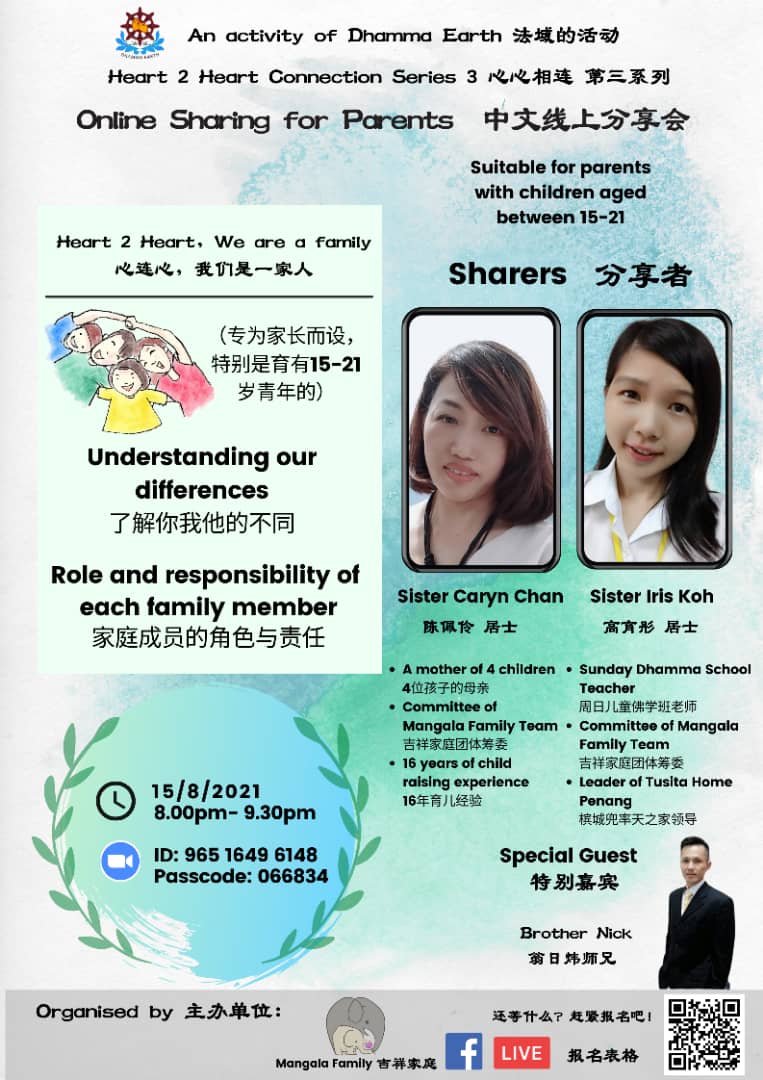

💕 Heart 2 Heart Connection Series 3
❇️Free Online Parent-Child Education Sharing
🎙️ Topic: Heart 2 Heart, We Are A Family
📆 Date: 15th August 2021 (Sun)
🕗 Time: 8:00 pm – 9:30 pm (7:50pm Login)
🗣️ Language: Mandarin
🎫 Free of Charge
🚩main session: Teen and young adult’s PARENTS
🚩breakout room: Teens & young adults who aged between 15-21
🎦 👉 Zoom Meeting
Zoom ID: 965 1649 6148
Passcode: 066834
😃👩💻 FB live 👉: Mangala Family
🙋♀️📑Register now at: ✒️👉registration form.
We welcome interested audience from all walks of life to join us.
For more detailed information, please refer to the 2 posters attached.
Sādhu! Sādhu! Sādhu!
🙏🌻😌
〔Heart 2 Heart Connection〕Parent-Child Education-Series 2 (for parents) Online Mandarin Sharing – “Love Begins at Home”

💕 Why do I not realize when my child express his love for me?
🤷♀️ Is my love for my family healthy?
🙋♂️ Join us in an exploration of LOVE !
Mangala Family Team of Dhamma Earth would like to present to you, the 3rd session of Parent-Child Education Online Series 2 with the aim to help parents gain understanding of how to express love and how to love skilfully.
This series is suitable for parents or guardian who have kids aged 8-14 years old. We also welcome interested audience from all walks of life to join us.
💕 Heart 2 Heart Connection Series 2
🎙️ Theme: Love Begins at Home
📆 Date: 20th June 2021 (Sun)
🕗 Time: 8:00 pm – 9:30 pm (7:50pm Login)
👤 Sharer: Sis Joanne Soo, Sis Iris Koh
🗣️ Language: Mandarin
🎫 Free of Charge
🎦 👉 Zoom Meeting (Interaction, Q&A)
Zoom ID: 995 7710 3954
Passcode: 764358
😃👩💻 FB live 👉: Mangala Family
🙋♀️📑This sharing session is opened to the public. You are encouraged to complete the following ✒️👉registration form.
👨👩👦 We welcome your participation in the sharing session. Let’s grow together with our family.
Sādhu! Sādhu! Sādhu!
🙏🌻😌
Renaming of Monastery and Center

Dear brothers and sisters in Dhamma,
In order to be more united and to simplify administrative work, Our meditation centers changed the name from “Tusita” to “Dhamma Earth”, with immediate effect.
• Tusita Hermitage, located at Kuching, East Malaysia will now be called “Dhamma Earth – Kuching Malaysia”
• Dhamma Earth, located at Semenyih (nearby Kuala Lumpur), West Malaysia will now be called “Dhamma Earth – Kuala Lumpur, Malaysia”
• Tusita Himalaya Hermitage, located at Nepal will now be called “Dhamma Earth – Himalaya, Dhampus, Nepal”
• Tusita Penang, located at Penang, West Malaysia will now be called “Dhamma Earth – Penang, Malaysia”
We will be updating the name in group chat and social media accordingly e.g.,
– Group chat(E.g., WhatsApp, Instagram)
– Social media (E.g., Facebook)
Other information e.g., office number remained the same.
For inquiries, please feel free to contact respective office numbers below:
Dhamma Earth Kuching – 019-858 2666
Dhamma Earth KL – 017-977 9100
Dhamma Earth Penang – 013-489 5568
Sādhu! Sādhu! Sādhu!
“A Dhamma Odyssey part 1”
“A Dhamma Odyssey part 2”